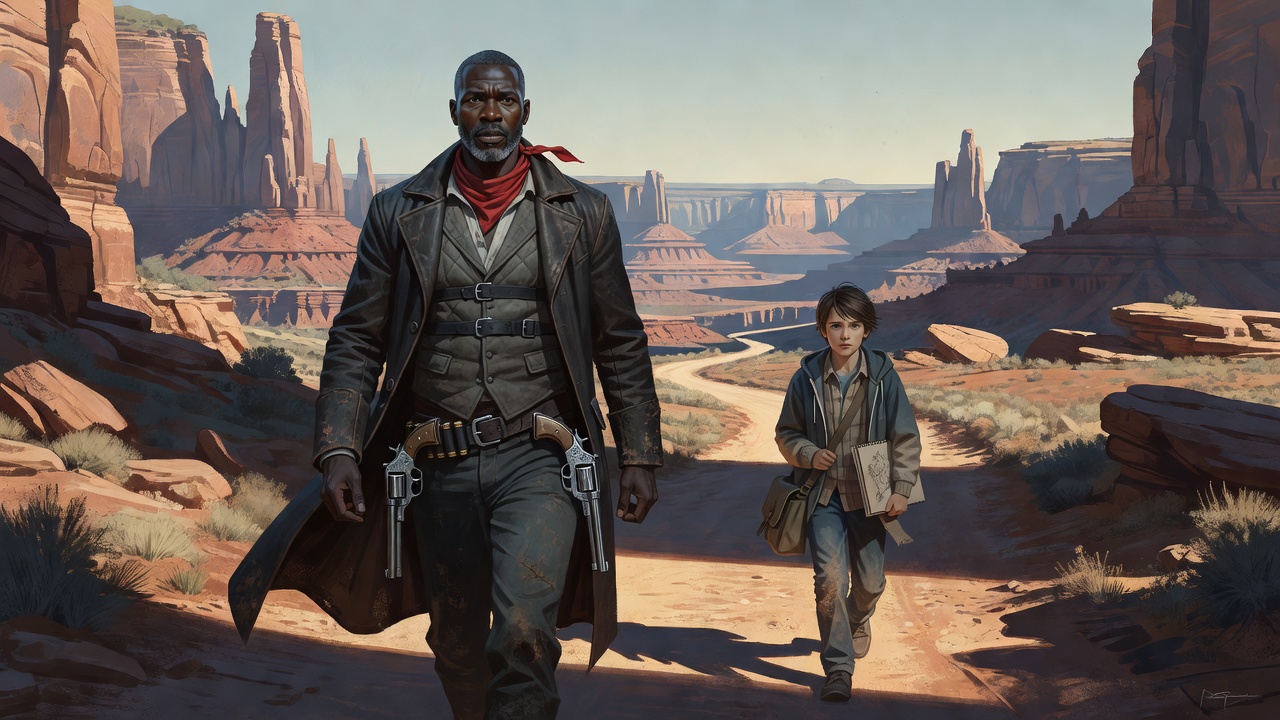
The 2017 film · Columbia / MRC · 95 minutes
The Dark Tower (2017)
A gunslinger, a boy, a man in black, and a machine that fires children at the Tower. About 3,000 pages, in 95 minutes.
The Dark Tower was directed by Nikolaj Arcel from a screenplay credited to Akiva Goldsman & Jeff Pinkner and Anders Thomas Jensen & Nikolaj Arcel, and released by Sony Pictures (a Columbia Pictures and MRC production) on August 4, 2017, after a premiere at MoMA on July 31. It runs 95 minutes and is rated PG-13. It cost about $60–66 million, opened at number one with $19.15 million on the slowest weekend of the summer, fell 59 percent the next weekend, and finished with $50.7 million domestic and about $113 million worldwide. Rotten Tomatoes settled at 16 percent, Metacritic at 34, CinemaScore at B. The Rotten Tomatoes consensus: “Go then, there are other Stephen King adaptations than these.”
It is not an adaptation of Book I, and its director said as much. Goldsman proposed to King that Roland already carry the Horn of Eld, the object the last page of Book VII hands him for the next turn of the wheel, so that the film would be the next time around rather than the first. King agreed, and on May 19, 2016 tweeted a photo of the horn lying in ash, captioned “LAST TIME AROUND”: “Soon Roland will raise the Horn of Eld. And blow.” Arcel called the result “a canon continuation.” The film itself never says the word loop; the horn is in Roland’s gear in set photos and the marketing, and whether it can be made out on screen is uncertain: one careful reviewer thought he glimpsed it and was not sure.
What it does with the books is take one element from each of several and bolt them onto a single chase: an eleven-year-old from New York (Books I and III), a plaster demon in a Brooklyn house (III), a restaurant of vampires (VI–VII), a machine that breaks the Tower with captive minds (VII), the creed and the opening line (I). The ka-tet, Mejis, Blaine, Mordred, the Crimson King as anything but graffiti, and the Tower as a destination are all gone. After three October 2016 test screenings in which audiences struggled with the mythology, about $6 million of reshoots went to backstory for Roland’s hatred of Walter and to orienting the audience in Mid-World. Below, the film as it plays.
The Horn and the Boy
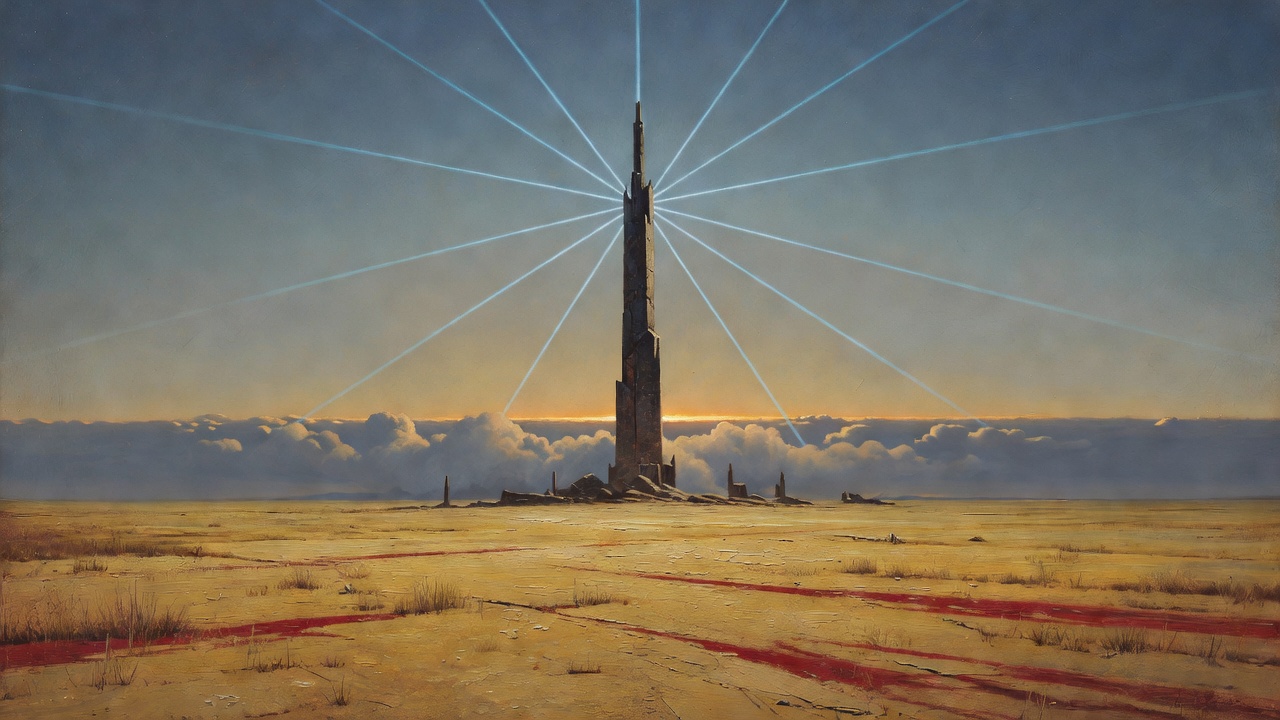
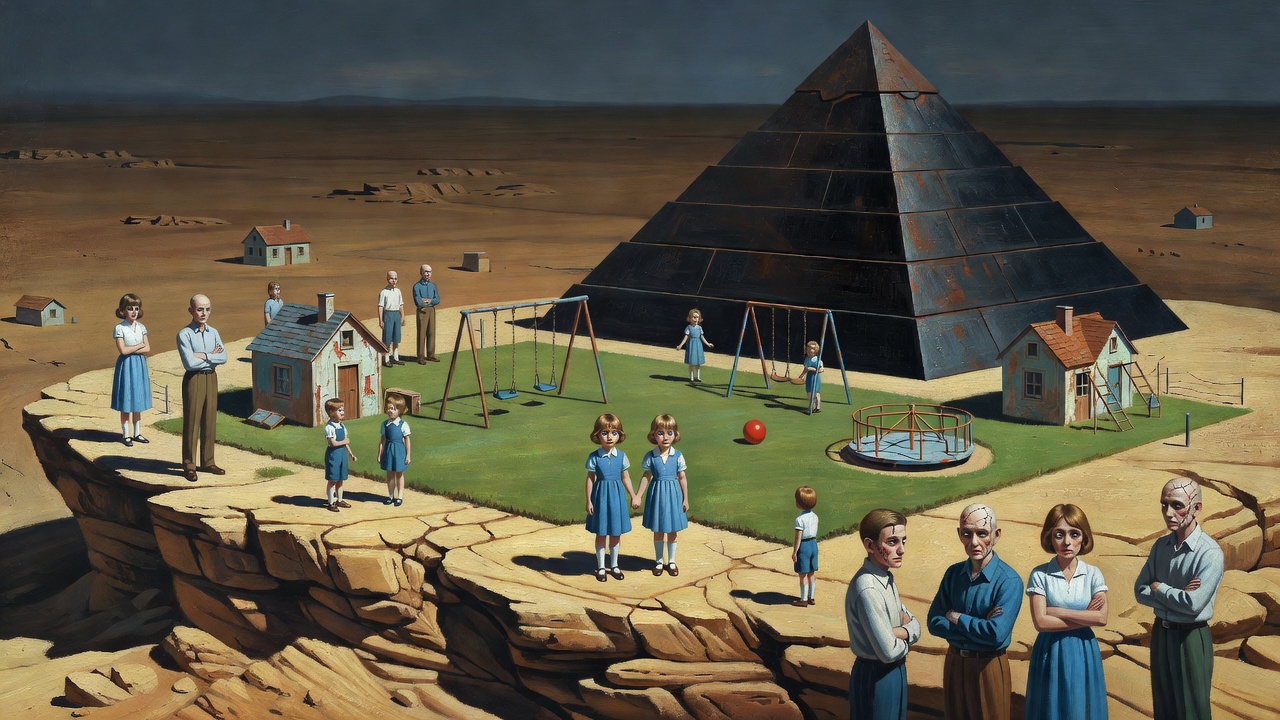
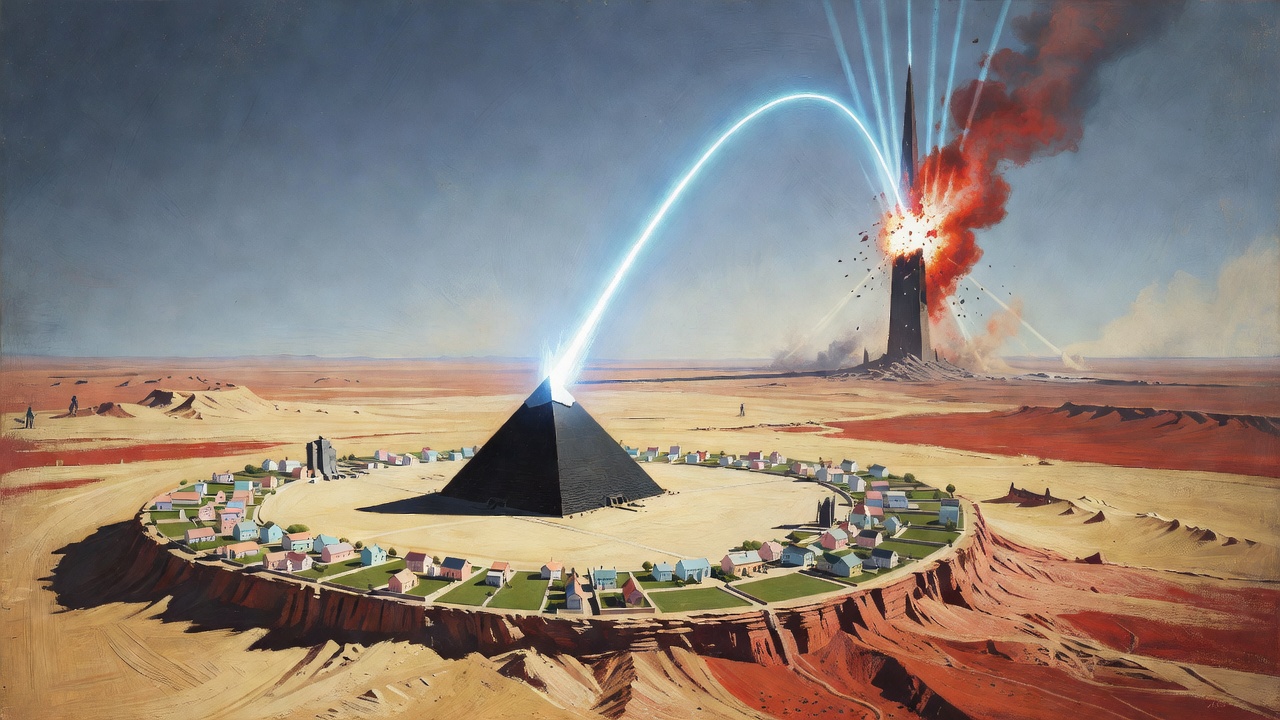
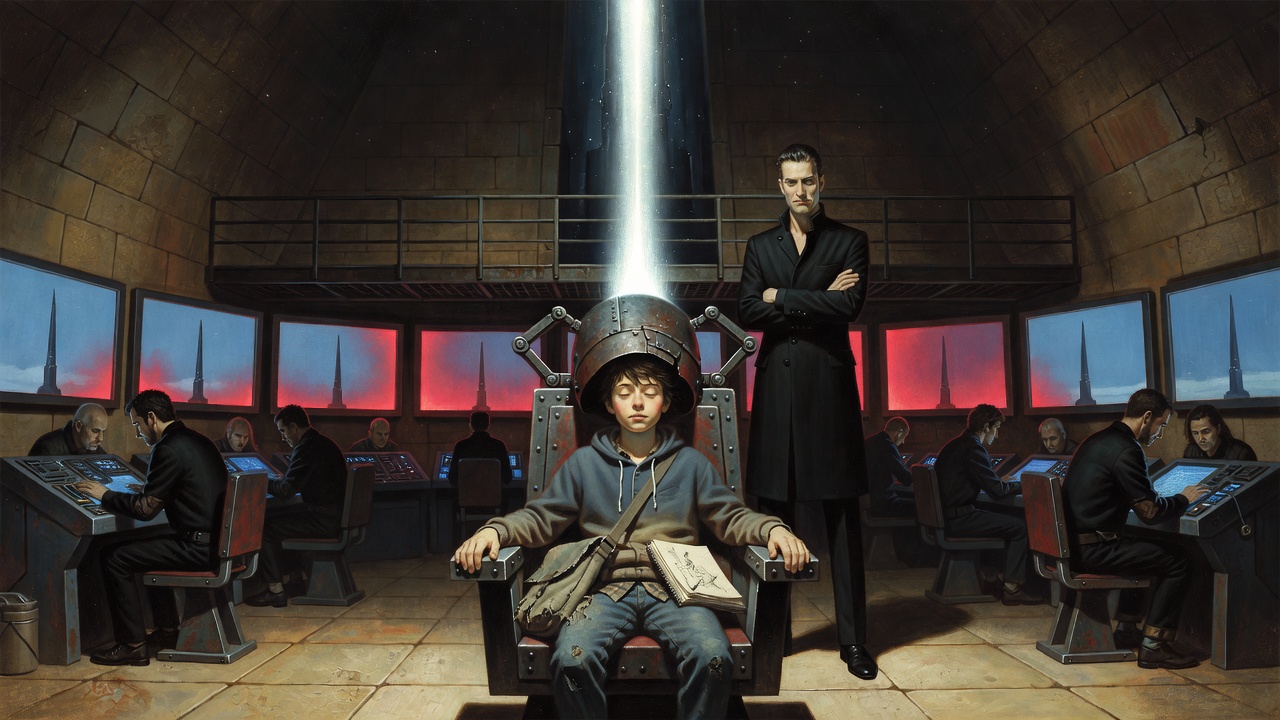
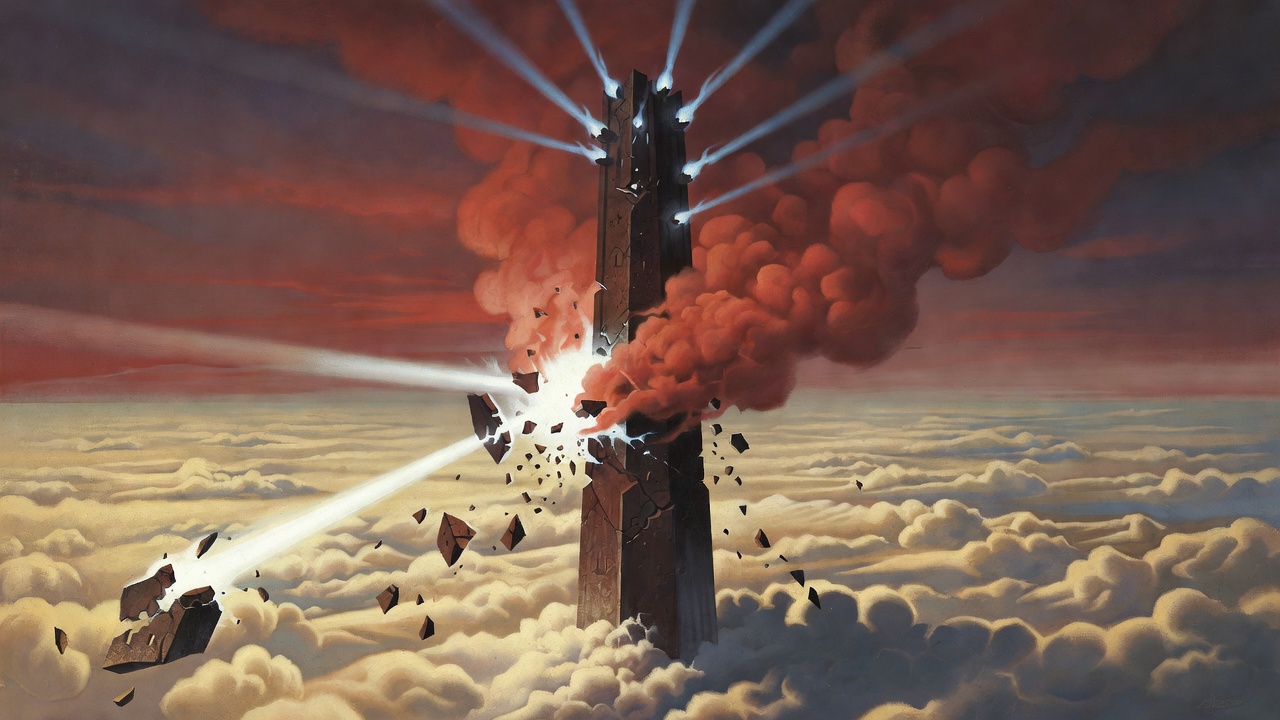
A white card on black: a Tower stands at the center of the universe, protecting us from darkness, and “It Is Said The Mind Of A Child Can Bring It Down.” Then sunlight. On a flat-topped butte above a brown wasteland sits a suburb too clean to be real: lawns, swings, children in 1950s colours, two small girls in blue chanting for someone to come and play. Adults with faces that sit slightly wrong watch from the edges. Wristbands beep, a siren sounds, and the chosen children file into a black stepped pyramid. Inside, a girl is strapped into a chair whose metal plates close around her skull. Her “shine” is drawn out of her as light and fired into the sky. The Man in Black watches it go. Far off, a slim dark spire with six pale beams radiating from it like spokes takes the hit, cracks, and burns in red smoke; over a city, a red tear opens in the air, and something is glimpsed behind it.
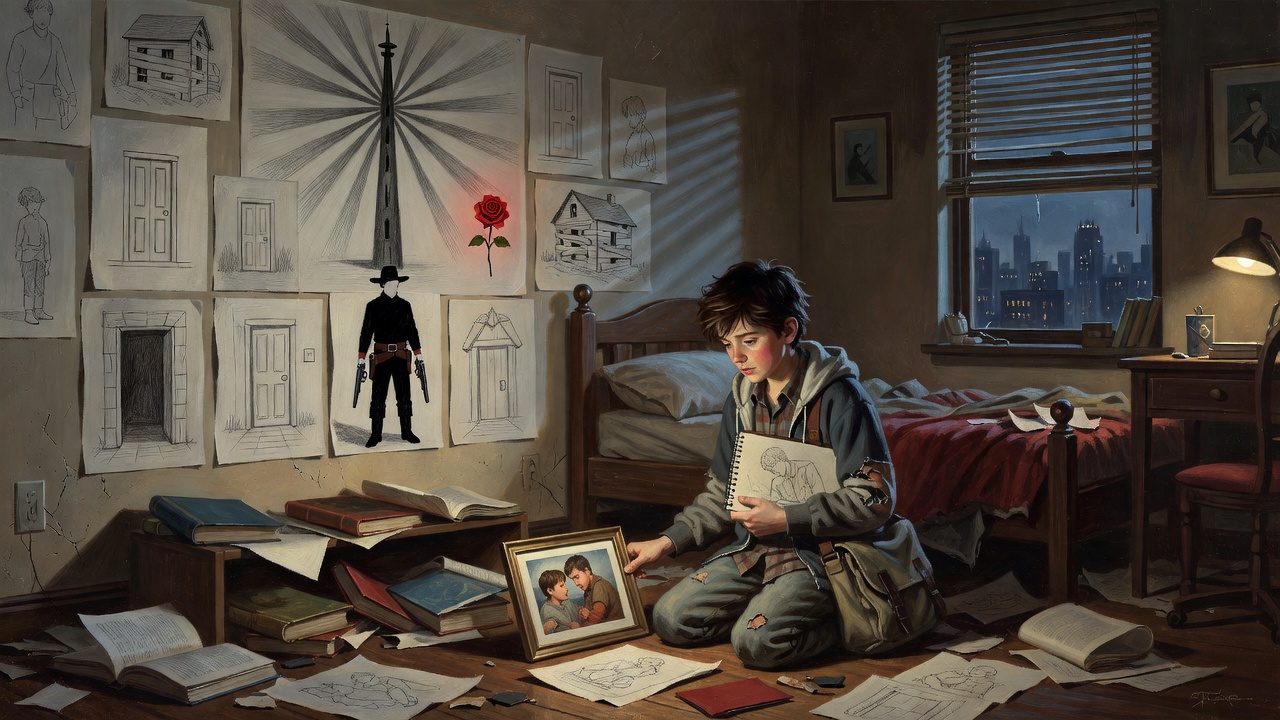
Jake Chambers, eleven, wakes in a New York apartment as an earthquake shakes the building. The one thing that falls is a photograph of him with his father, a fireman killed a year earlier. His mother Laurie comes to check on him. Jake draws what he dreams, and his wall is papered with it: the Tower, the man in black, a gunslinger with two guns, doors, a rose, nineteen and nineteen again. At school a bully grabs the sketchbook and Jake beats him until he is pulled off. A therapist whose desk carries a framed photograph of the Overlook Hotel assures him the quakes are quakes. Leaving the clinic he sees one of the dream’s creatures across the street, in a man’s skin; a homeless man tells him they take the special ones. He runs for a bus.
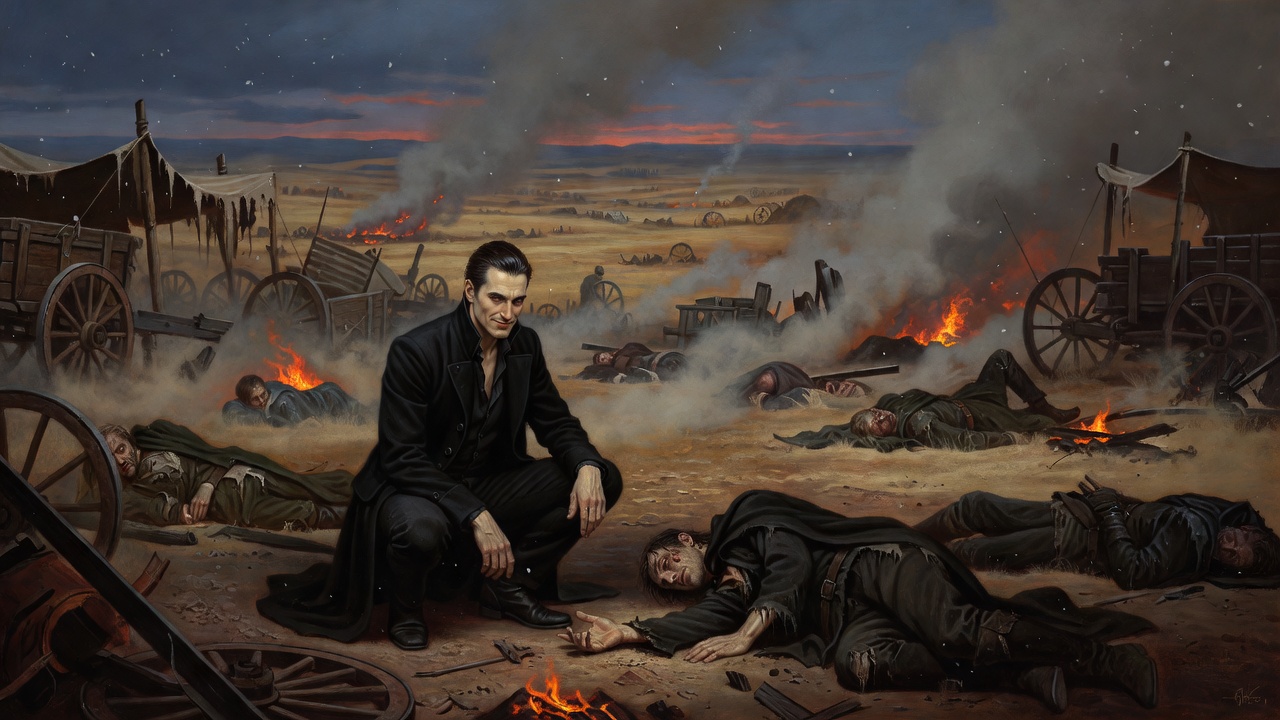
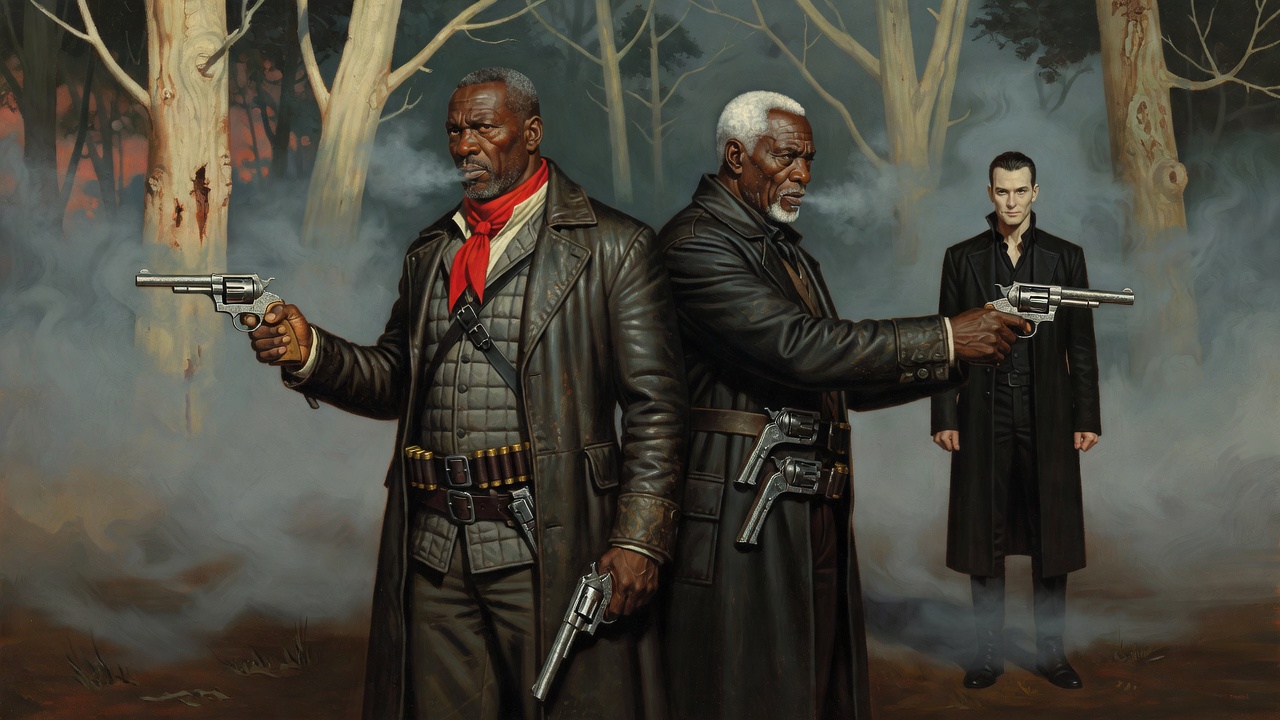
The dreams sharpen. A smoking battlefield the film never names, bodies in the ash; the Man in Black, whistling, crouches beside a dying man, tells him there is nothing on the other side, and sets him alight with a gesture. Then a misted wood and two gunslingers, father and son, reciting their creed together against a voice that answers from everywhere. Walter tells the father to “Stop breathing,” and Steven Deschain suffocates in his son’s arms. Roland alone shrugs off the magic; he fires, and Walter catches the bullet behind his back. Over the last of the dream a voice says the oldest line in the saga:
The man in black fled across the desert, and the gunslinger followed.
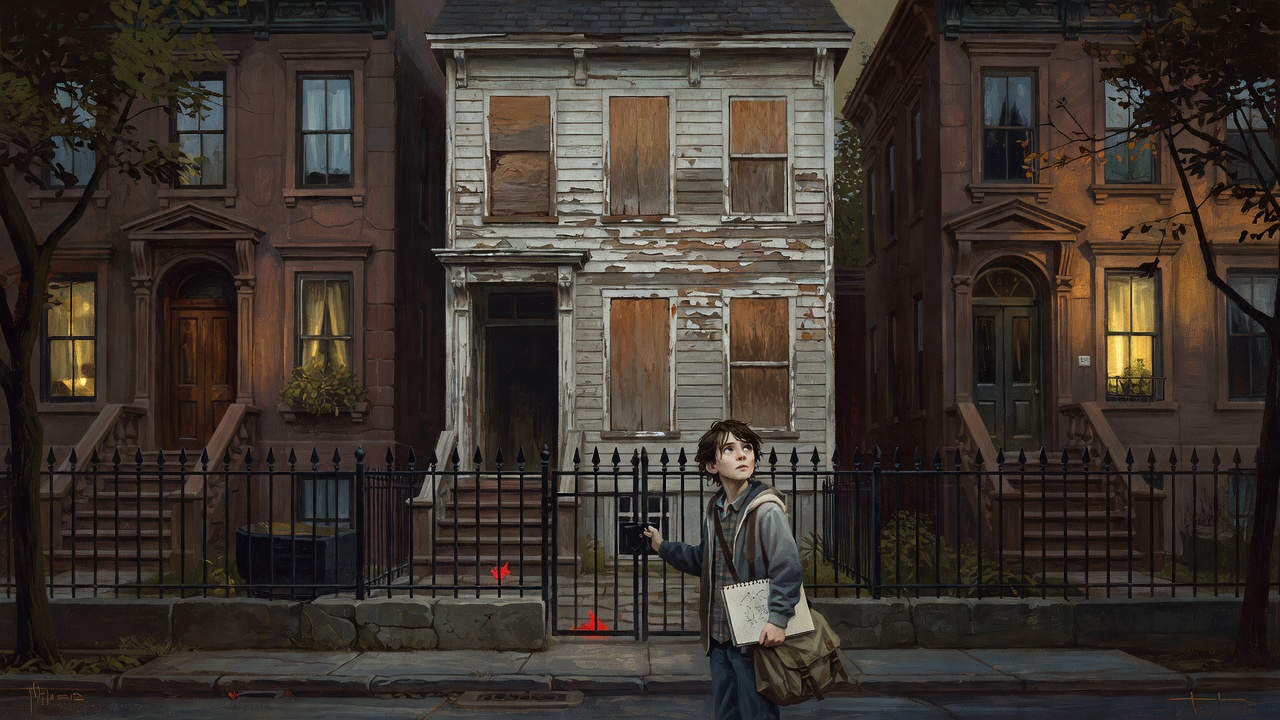
The dream ends on a boarded white house behind a black iron fence.
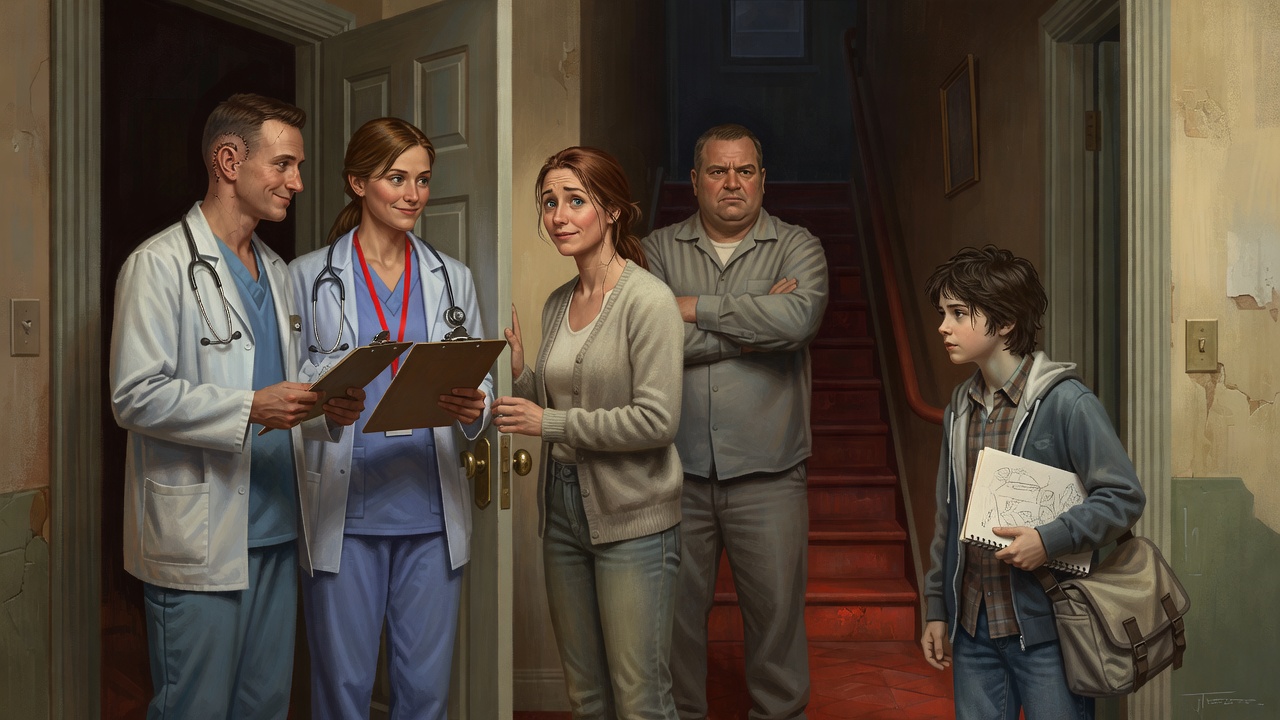
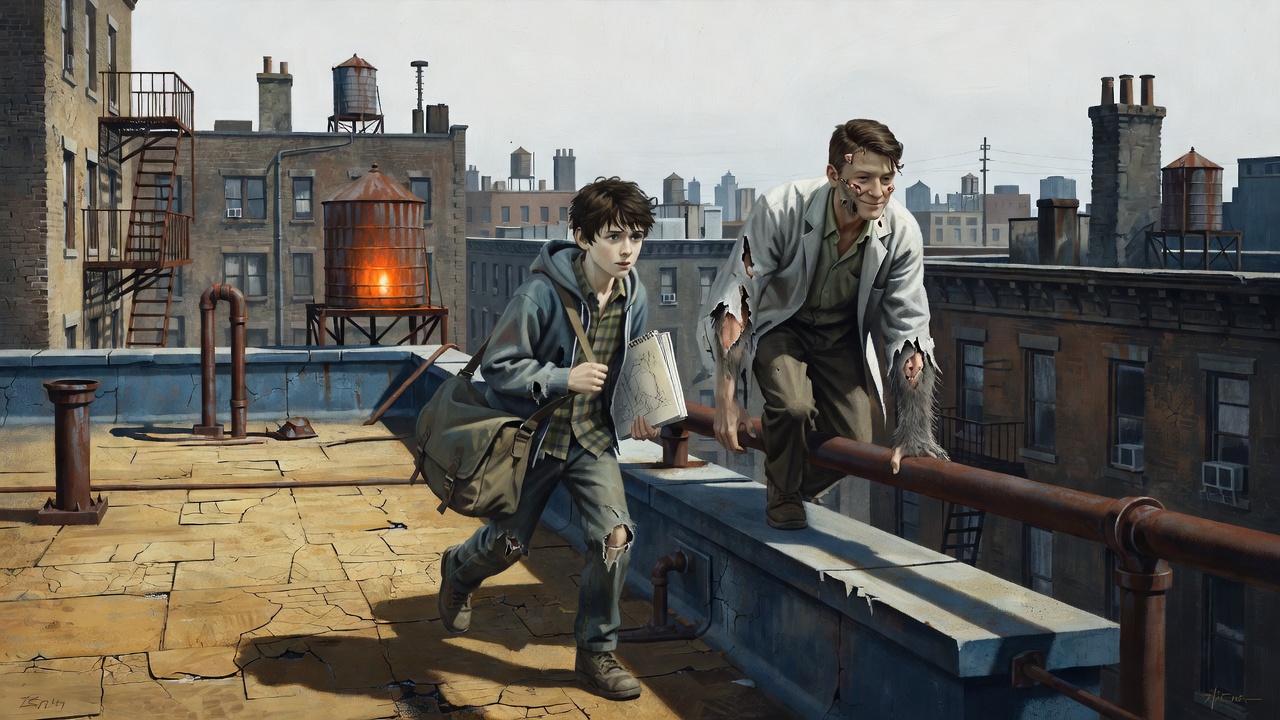
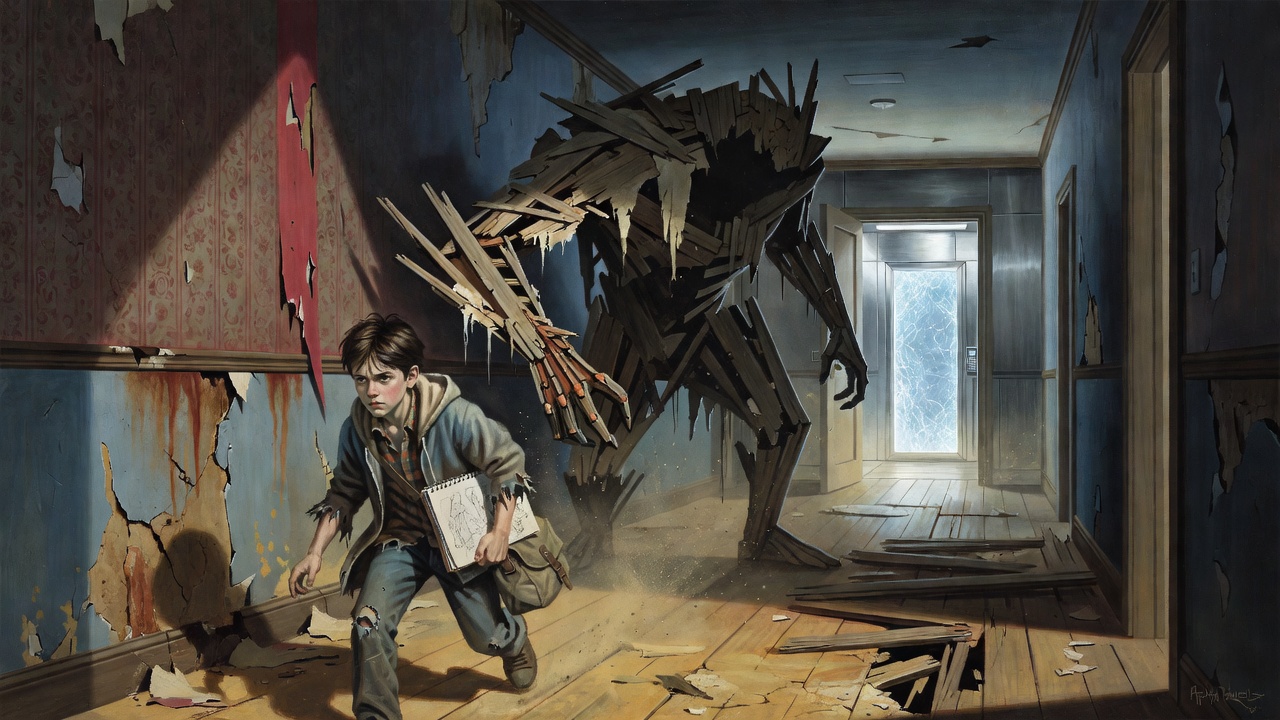
Jake posts a drawing of the house to a forum; a reply places it in Brooklyn. At Lon’s urging, two workers from a clinic upstate come to collect him. Jake sees cracked, twitching hands and a stitched seam behind the driver’s ear. His mother will not listen; Lon says he goes willingly or by force. Jake asks for his toothbrush, climbs out the bathroom window onto the roof, and the driver, hauling himself after him, tears his skin open on a pipe: grey rat fur underneath. Jake loses them in the subway and finds the house. Inside, the house itself heaves up out of its own walls and floor, plank and plaster, to stop him. Beyond it is a sterile room of steel and glass with a keypad and a doorway full of light. He enters the code, nineteen-nineteen, and steps through.
Mid-World
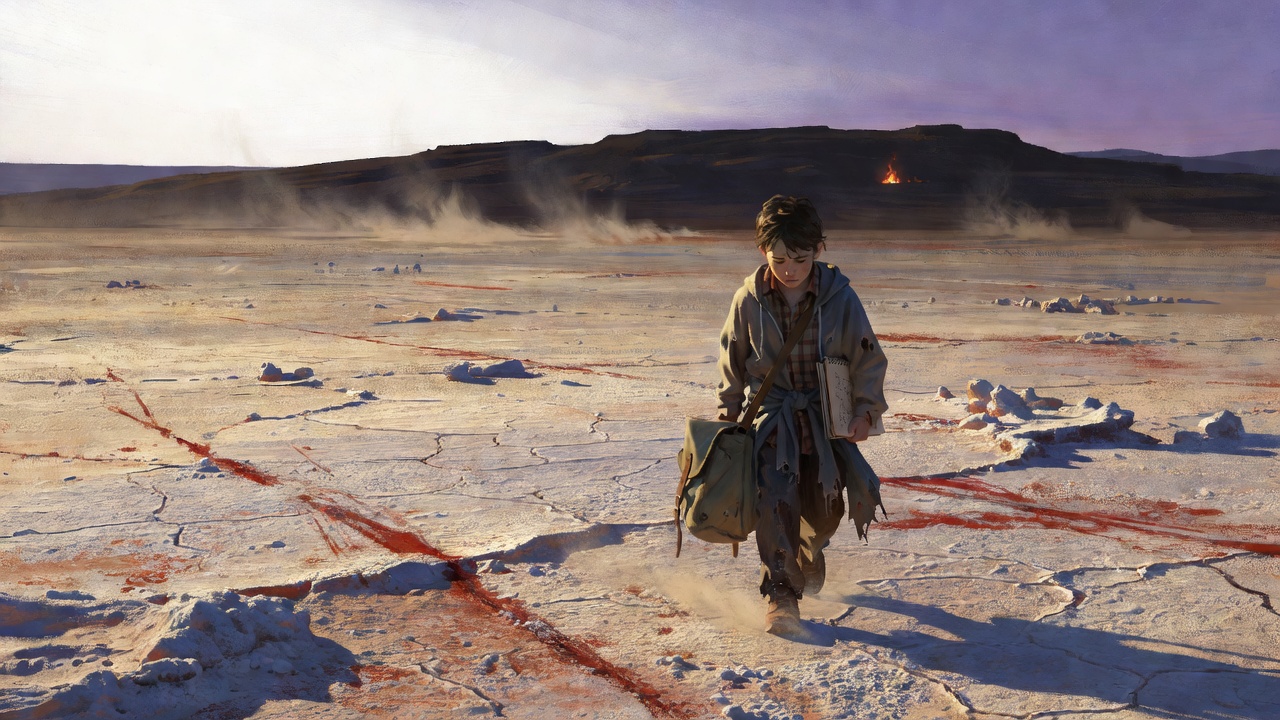
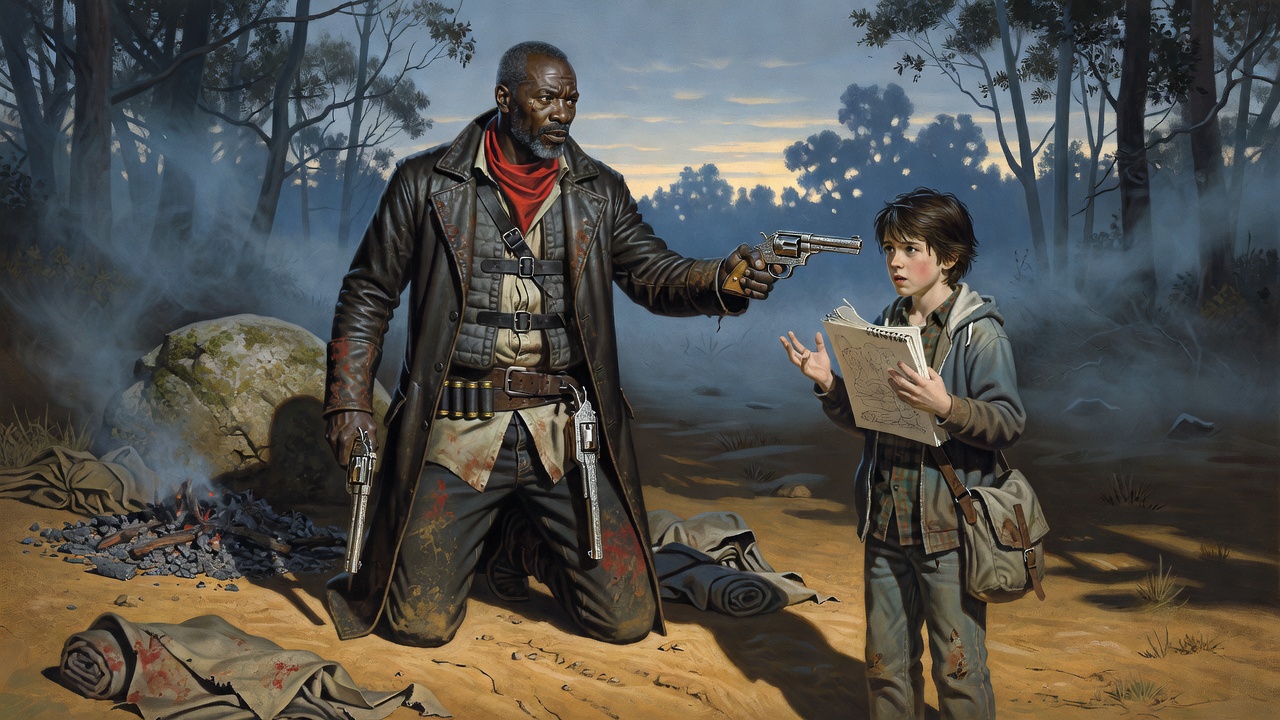
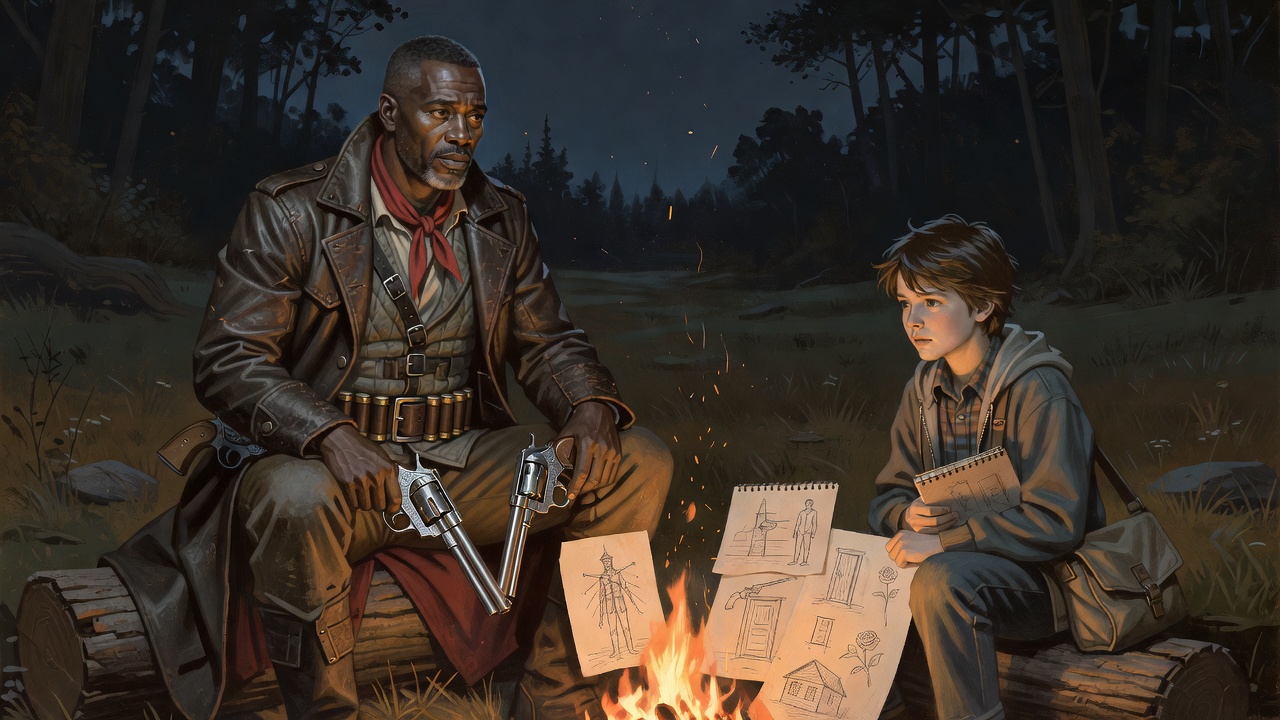
White hardpan under a white sky. This is the Mohaine Desert, and it is the boy who crosses it, not the gunslinger; there is no Tull and no Way Station. Near collapse from thirst, he sees at dusk a fire on a far hill. In the woods beyond it a sleeping man comes up off the ground in one motion with a huge engraved revolver in his face. Roland Deschain, last of the gunslingers, takes him for Walter’s trick, at one point dangling him over a cliff edge, until the drawings persuade him. By the fire he explains what the drawings mean: the Tower holds the dark out; Walter is feeding it children with shine; he himself hunts the man who killed his father, and wants nothing else. Roland asks whether they have guns and bullets in the boy’s world. “You’re gonna like Earth. A lot.”
At his base, Walter learns from his man Sayre that the Dutch Hill portal has been used, and that the boy who used it has pure shine, enough on his own to bring the Tower down.
The walk takes them through a fog-bound forest where a rusting amusement park stands among the trees. That night Jake hears his father calling from the dark. A thing wearing the father’s shape leads him toward the treeline before it shows itself; it tries Steven’s face on Roland, who is not fooled and shoots it. When a second creature comes, Jake picks up a gun and fires. Roland explains: every strike on the Tower tears the fabric between worlds, and things get through.
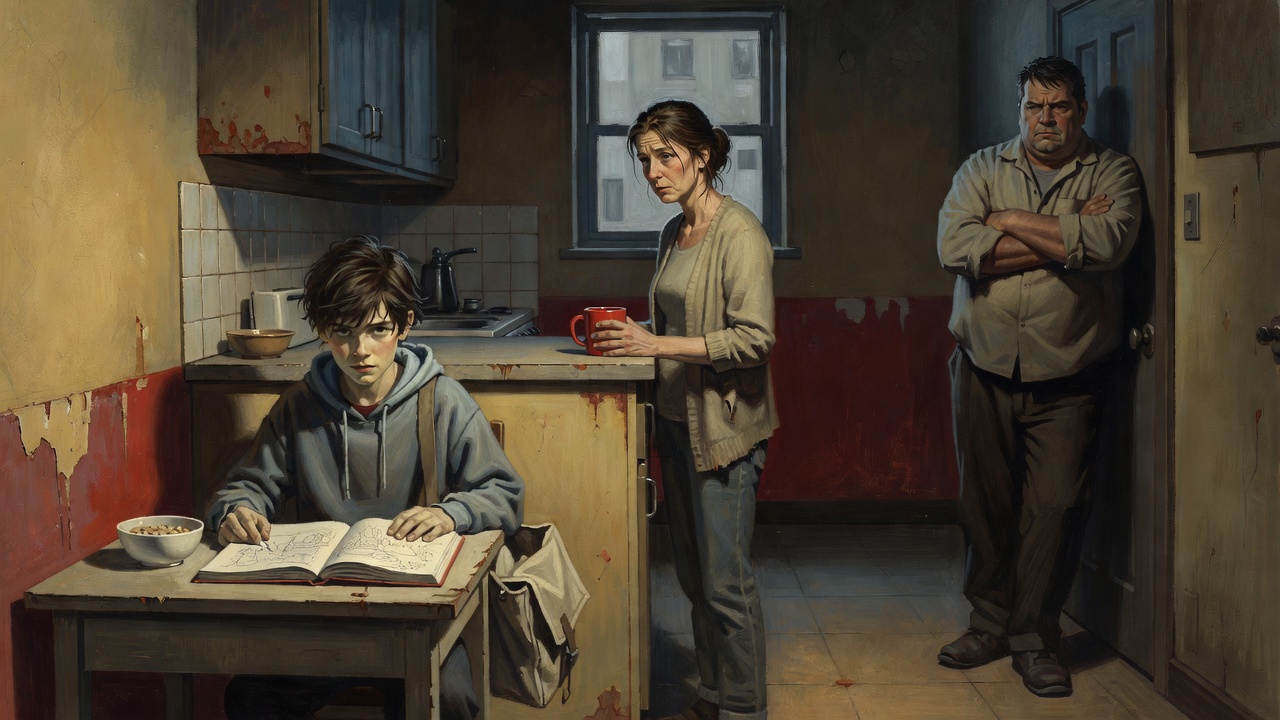
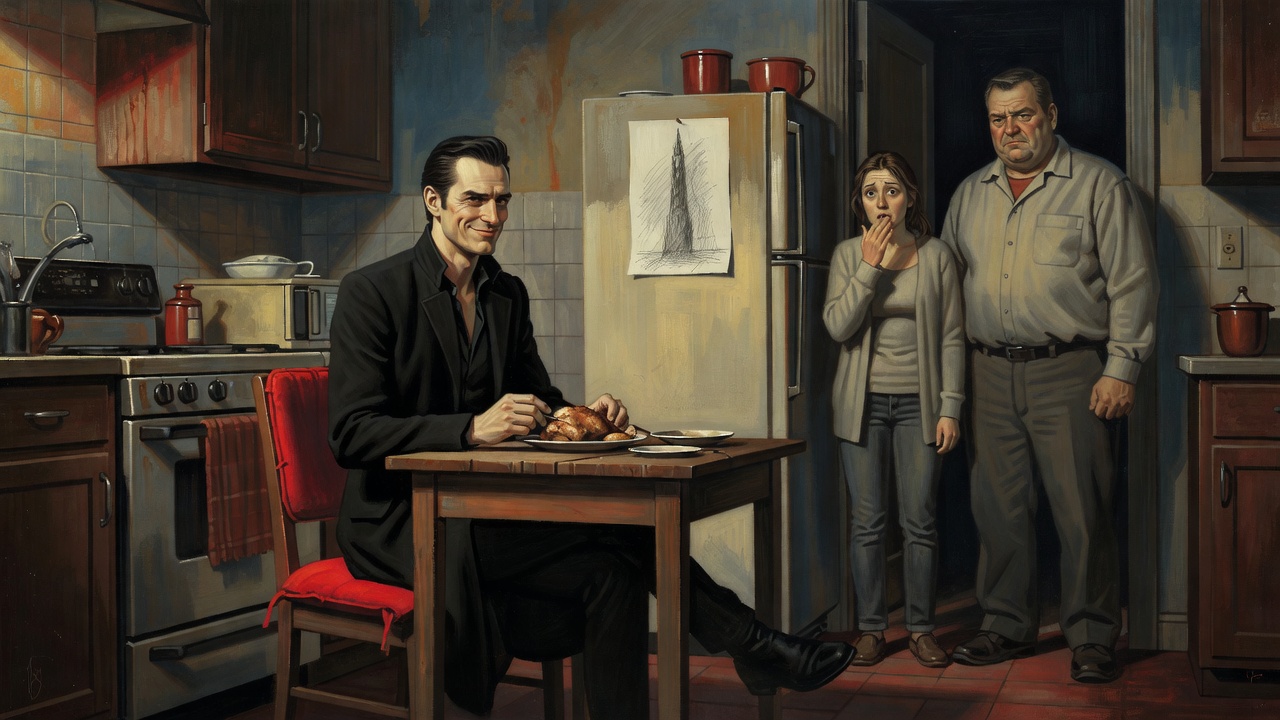
Walter, meanwhile, walks into New York past graffiti hailing the Crimson King. He lets himself into the Chambers apartment and is eating chicken at the kitchen table when Laurie and Lon come home. He kills Lon with a word, makes Laurie show him her son’s drawings, and burns her. On his way out he leaves a smiley face.
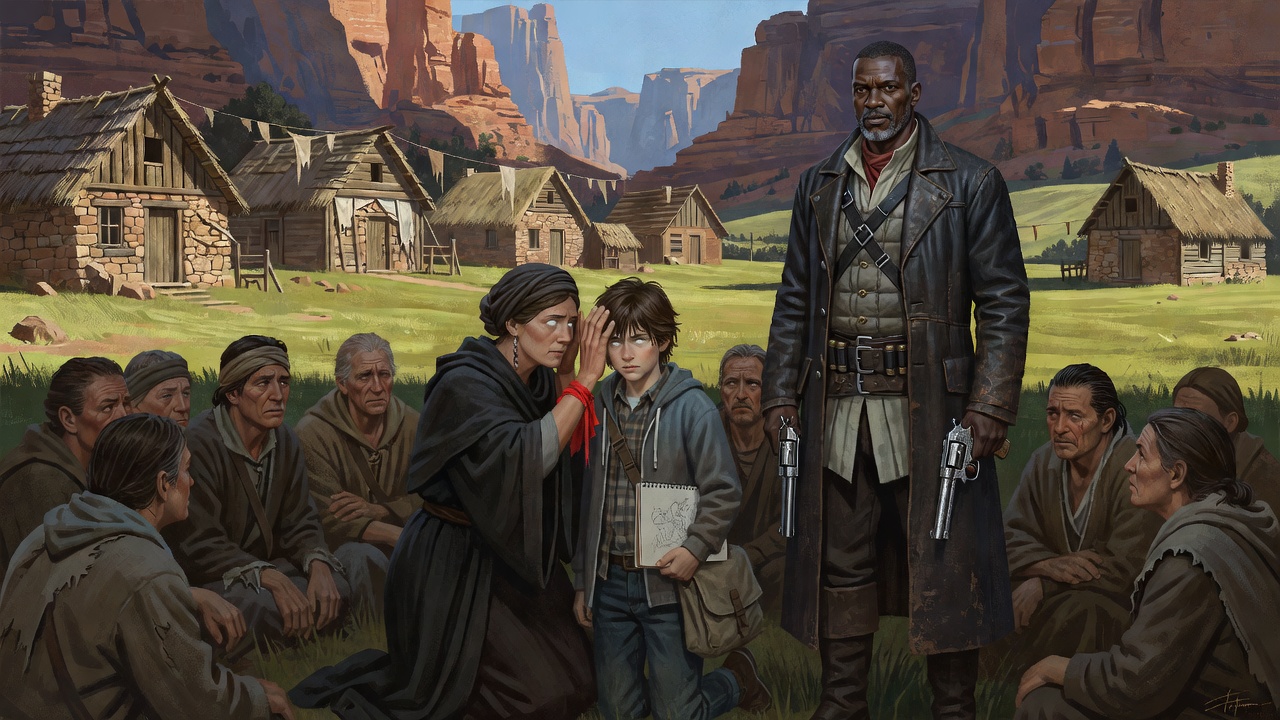
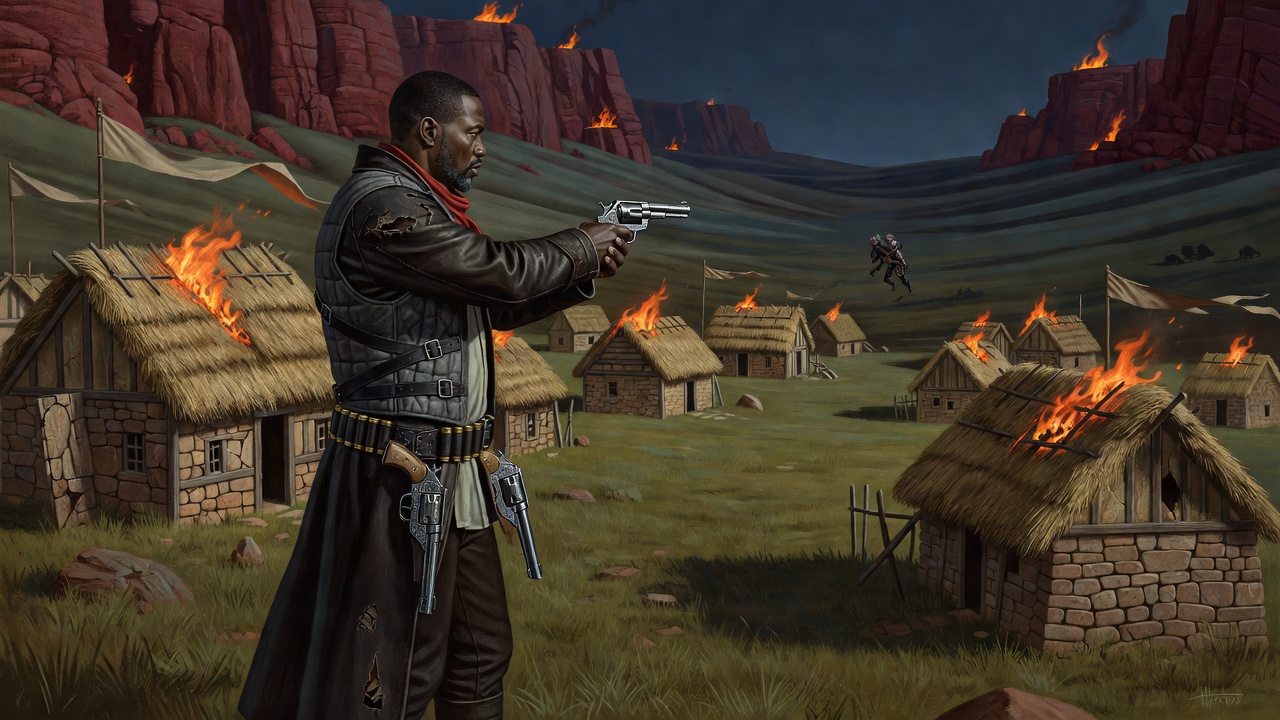
Roland brings Jake to a village of seers in a green valley, the film’s Manni. The seer Arra puts her hands on the boy and sees the machine: six months on foot, but reachable through Walter’s own portals from his base in New York. That night Walter’s trackers hit the village, and with their human masks off they are rats walking upright. Roland kills them one at a time and takes a round in the shoulder. One carries Jake off into the dark; Roland steadies, breathes, and drops it at long range. They leave Mid-World through a village portal, and Jake is told to remember its code as the way back.
New York
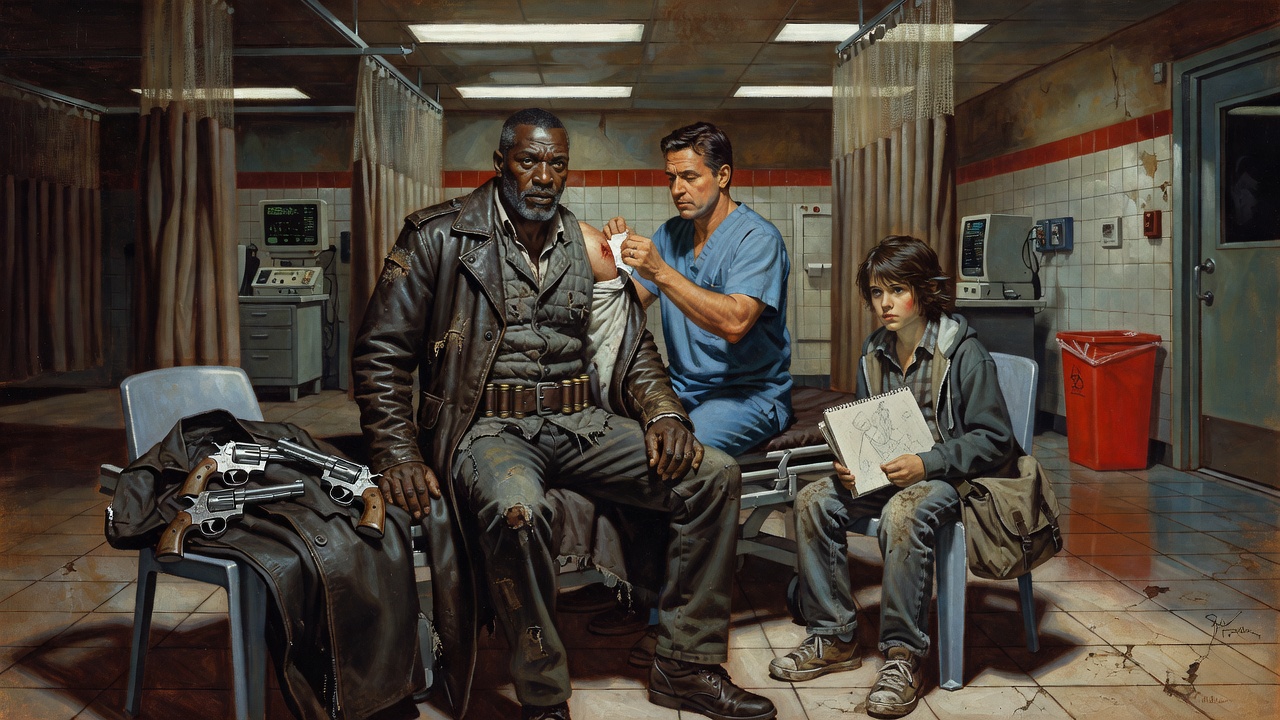
An emergency room on the New York side, in the world the books call Keystone Earth; reviewers used the name for the film’s New York, and whether anyone says it aloud on screen is unconfirmed. A doctor dresses the shoulder. Roland pays with a coin, pockets the painkillers, and swallows them on a city bus with a Coke. A raccoon in a commercial prompts him to ask whether the animals here still speak; two drunk girls who flirt with him are told they have forgotten the faces of their fathers. The homeless man from Jake’s first day tells Jake where the skin-men take the children: a restaurant called the Dixie Pig.
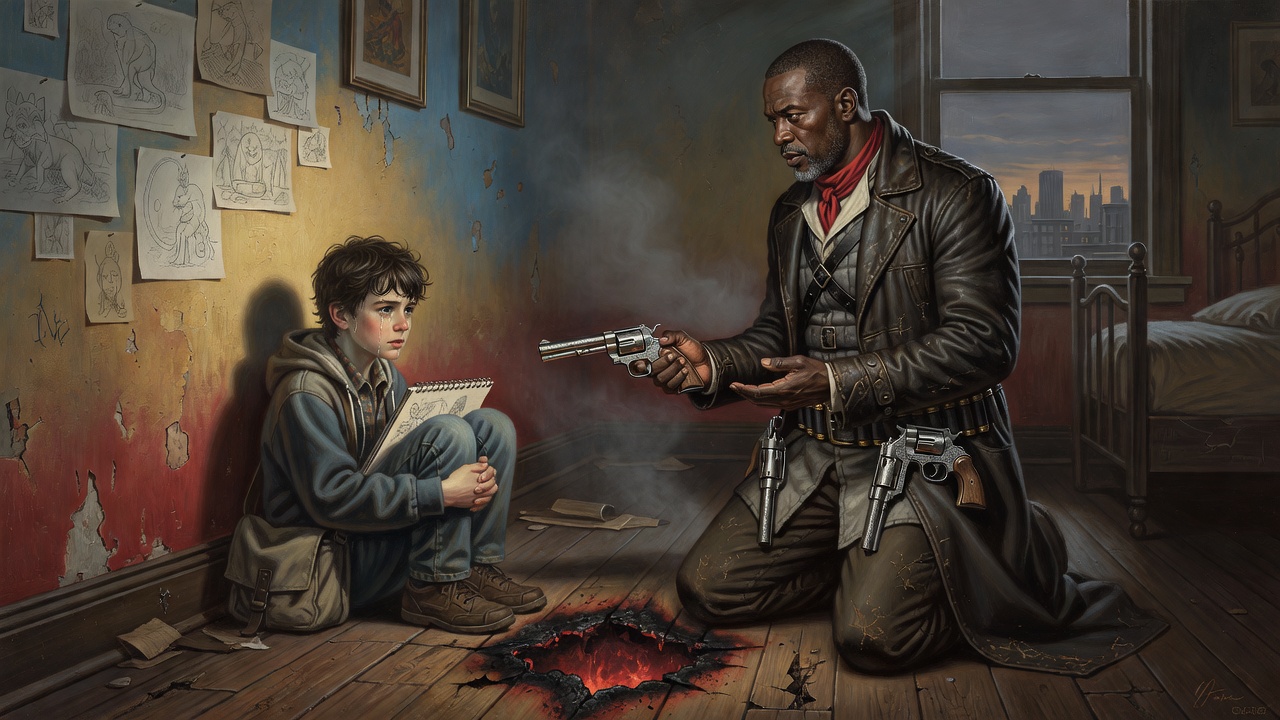
Then the apartment. Lon is dead on the living-room floor. In Jake’s bedroom a scorched hole has been burned through the boards, and Jake sees, in a flash, what happened to his mother. He breaks down. Roland vows to kill Walter, and teaches the boy the words he has not spoken aloud since his own father died, Cort’s catechism from the books: “I do not aim with my hand ... I aim with my eye.” “I do not kill with my gun ... I kill with my heart.” He puts a revolver in Jake’s hands and shows him how to hold it. It is the film’s one sustained use of King’s language, and it is spent well: the boy will say it back at the moment it matters.
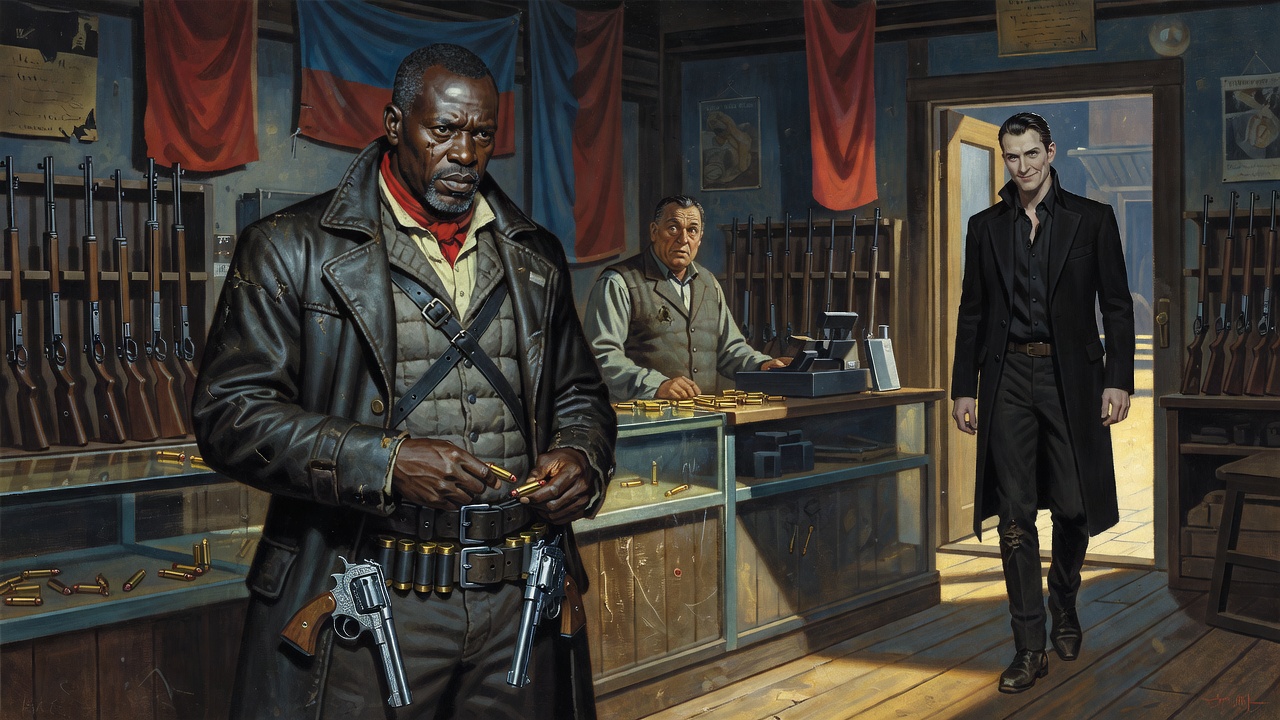
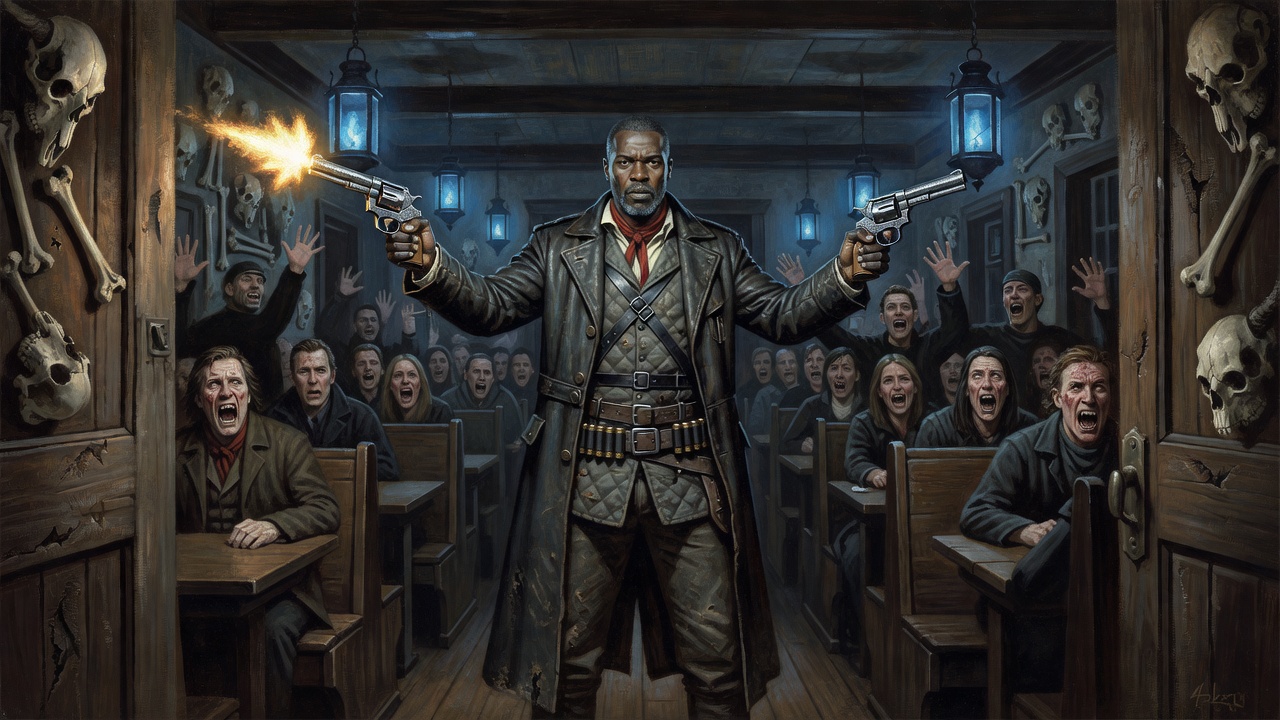
A gun shop. Roland buys ammunition beneath a Rita Hayworth poster, and Walter walks in behind him. He turns the clerk’s gun on the gunslinger and hurls him around the shop without touching him. “Darkness is your weapon, guns are mine.” Outside, Walter’s people take Jake. Roland goes to the Dixie Pig alone: a dim blue-lit room hung with bones, low men and vampires in the booths, Books VI and VII’s restaurant kept nearly intact and made Walter’s New York base. He comes through the door with both revolvers up and shoots his way to the portal at the back. The code he needs arrives in his head, sent by Jake from the far side.
The Devar-Toi and the Duel
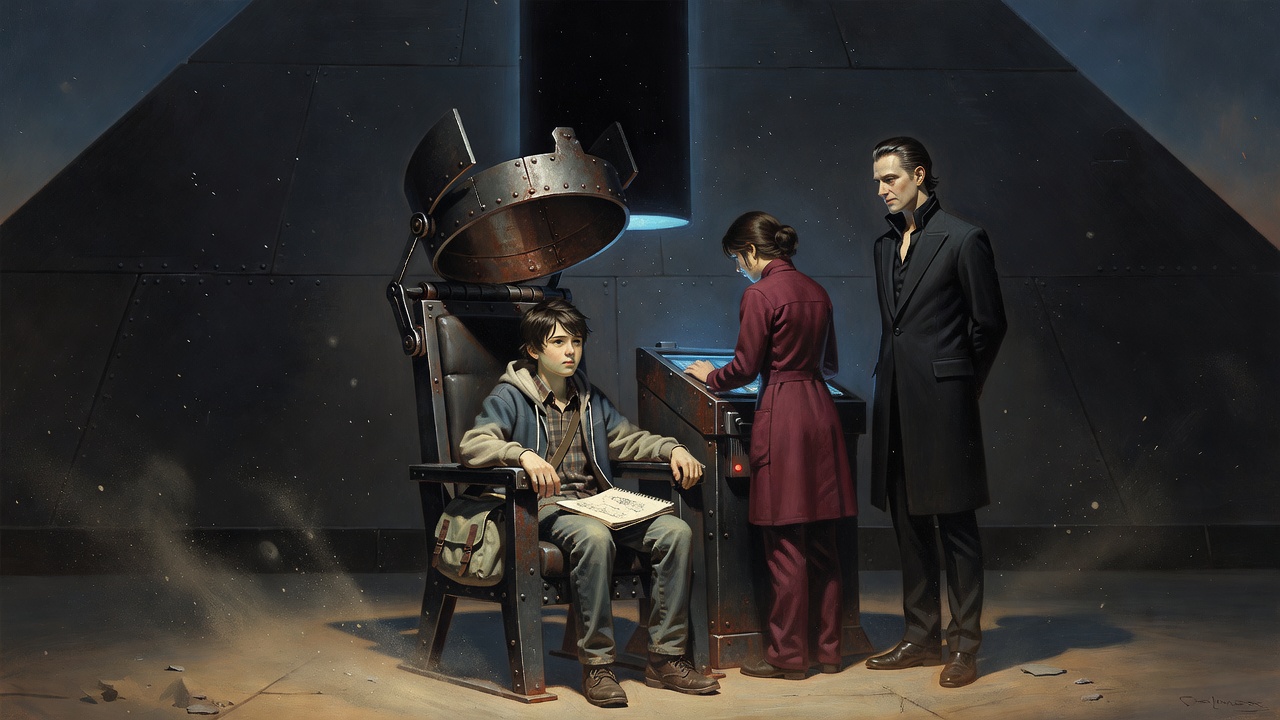
Walter brings Jake through to the pyramid and a woman technician straps him into the chair. The plates close; the beam fires. In New York the ground shakes and the sky turns red. Then the technicians’ levels plateau: the kid is fighting the machine from inside it, and holding the portal open. Roland comes through and clears the facility room by room, Sayre and the technicians and the rat-faced guards.
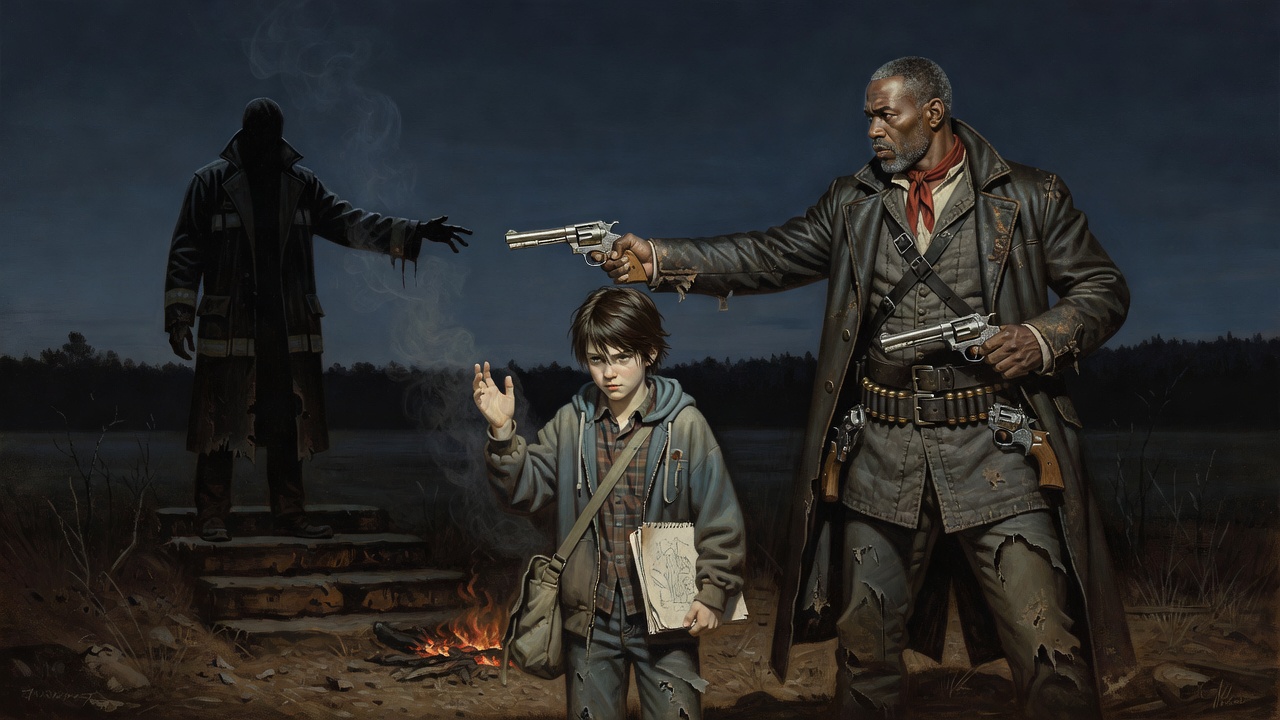
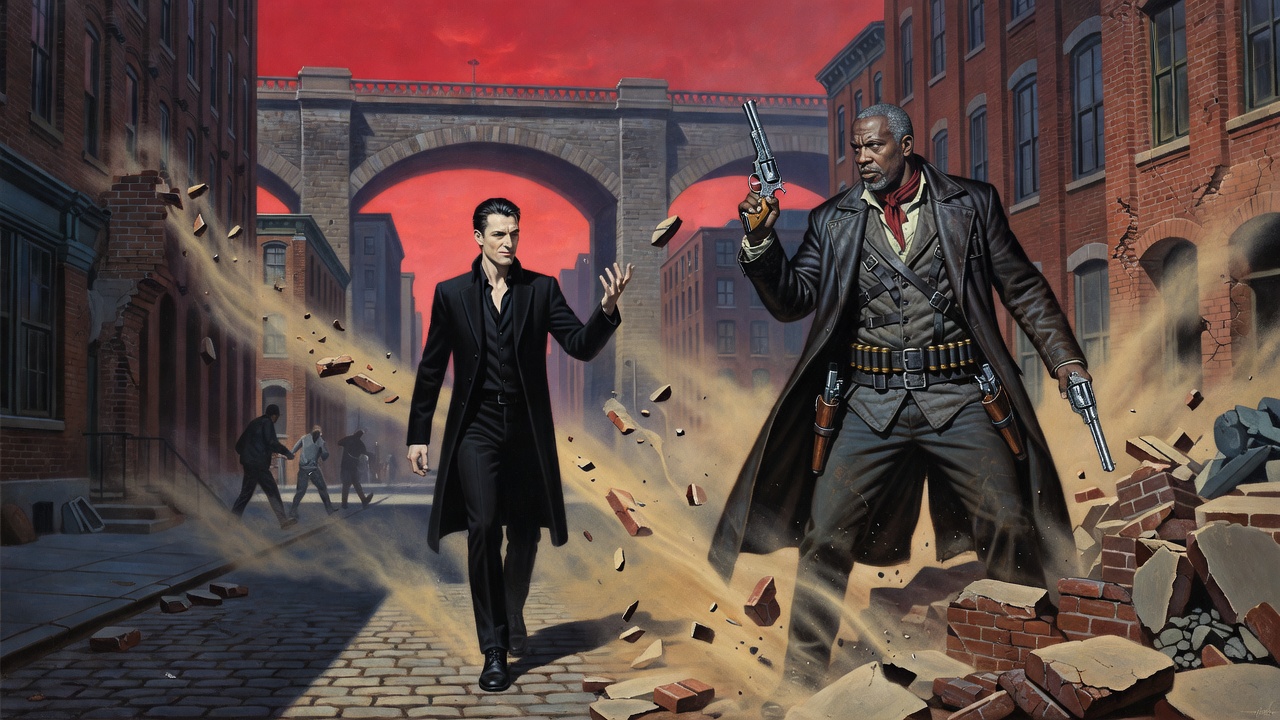
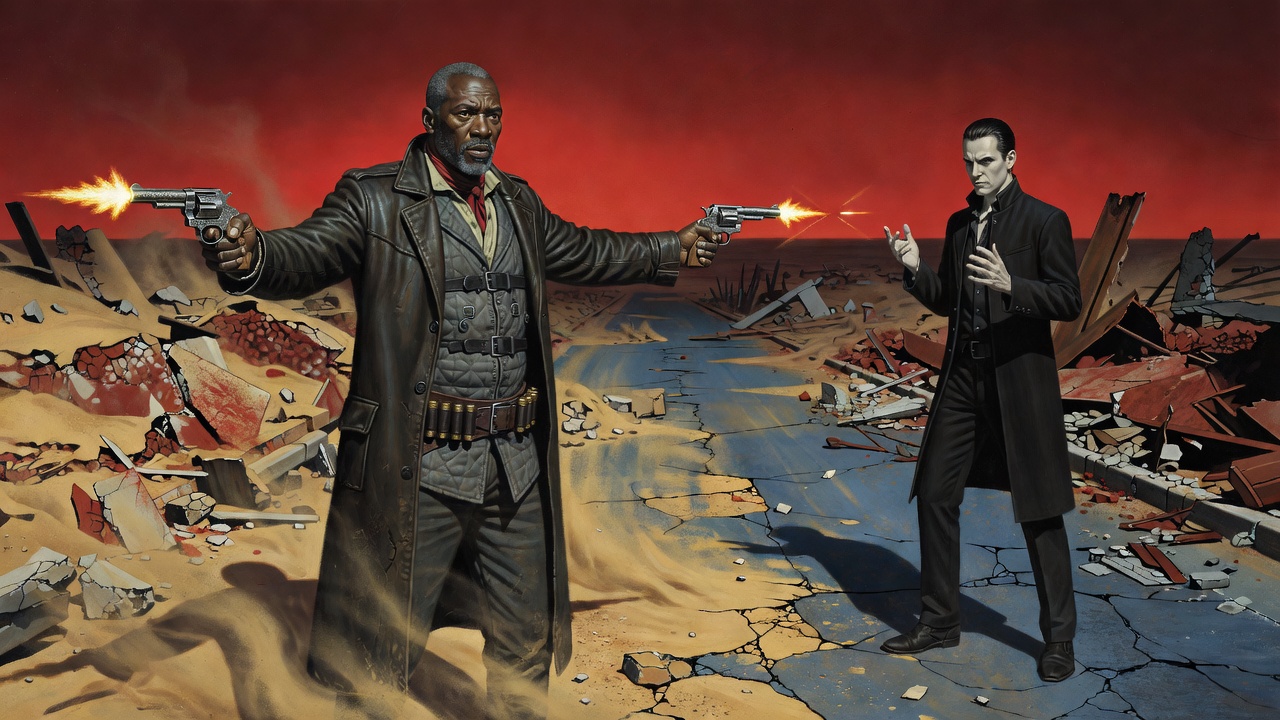
With the machine failing, Walter returns to the street outside his New York base, and Roland follows. The duel is the one piece of the climax with no counterpart in the novels, where Walter never fights Roland at all and is eaten by Mordred in Book VII. Walter brings masonry down with a raised hand, throws Roland into the rubble, and deflects every bullet. “Everyone who walks with you dies.” “No more.” In the chair, Jake recites the creed into Roland’s mind. Roland fires, then fires a second round into the first to bend its path around Walter’s catching hand; it takes him in the chest, and a head shot finishes him. Arcel later allowed that, for him, Walter did not die. Roland shoots out the machine. The pyramid blows apart, the children are freed, the sky clears.
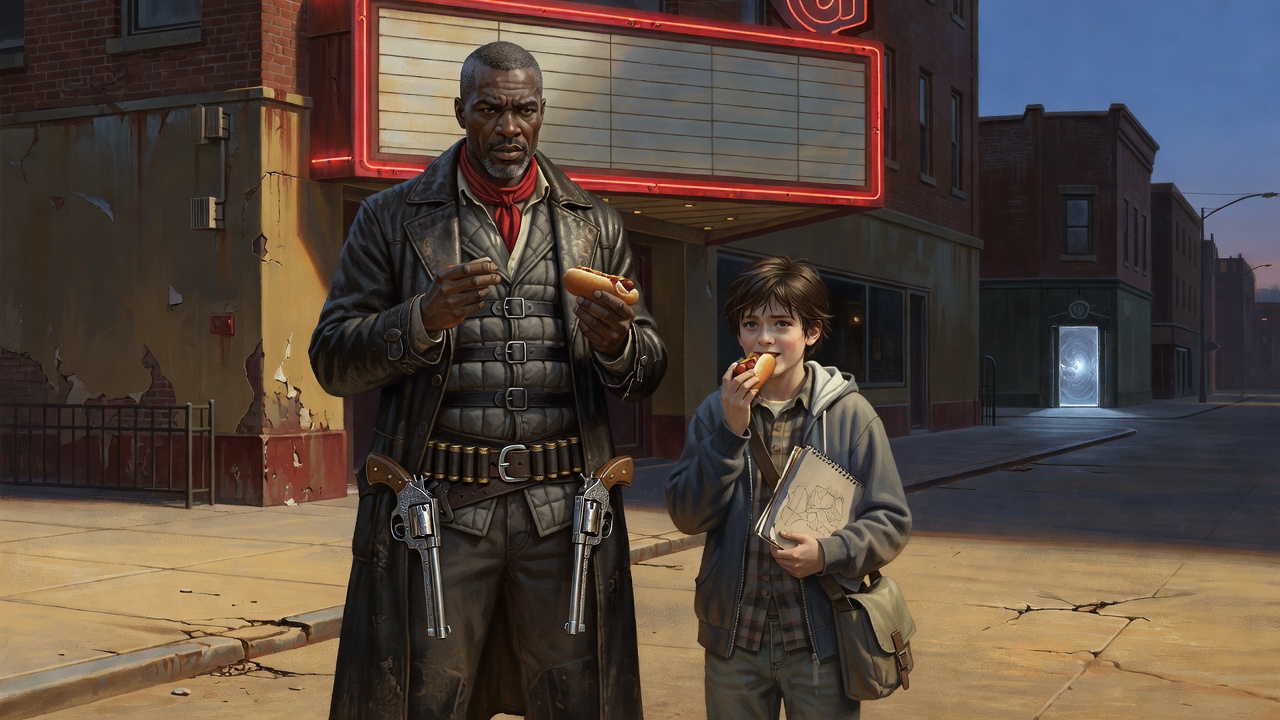
Under a theater marquee, Jake hands Roland a hot dog. “Savages. What breed?” Roland must go back to his own world. He offers the boy a place at his side, and Jake, who has no one left, takes it. The two step through the portal for Mid-World. There is nothing after the credits but a whistle at the very end of them.
What the film is doing, finally, is the one thing the continuation idea was good for: a gunslinger who, this time around, does not let the boy drop. It never says so, and it never shows the Tower as anywhere a person might walk to; but the shape is there, under the keypads and the hot dog.
What it took from the books
- The opening line (Book I). “The man in black fled across the desert, and the gunslinger followed” is spoken as narration over Jake’s dream; King insisted on it.
- The creed (Book I; recited as Cort’s catechism in Book IV). Roland and Steven say it together, Roland teaches it to Jake in the apartment, and Jake says it back into his mind in the duel. It is the film’s main use of King’s language.
- The Mohaine Desert (Book I). Walked by Jake, not Roland; no Tull, no Way Station, nobody fleeing ahead.
- Jake Chambers (Book I’s boy at the Way Station; the Brooklyn crossing is Book III’s). He walks through a door alive instead of dying into Mid-World, so there is no sacrifice under the mountains to undo.
- The Dutch Hill house and its doorkeeper (Book III). The plaster demon survives; the magic door it guards becomes a technological portal with a keypad.
- Walter Padick (the birth name is from Book VII). Used openly, with “Walter o’Dim”; no Flagg, no Marten.
- The Breakers and the Devar-Toi (Book VII), merged with the Calla’s harvested children (Book V): adult telepaths on a pampered campus become kidnapped children strapped into a machine.
- The Dixie Pig (Books VI–VII). Still a restaurant of low men and vampires with a door to somewhere else; now Walter’s New York base.
- Taheen and can-toi (Book VII, with V–VI). The film calls its creatures taheen but gives them the can-toi’s living human mask with its seam behind the ear and rat fur beneath.
- Sayre, Pimli and Tirana (Books V–VII). The Sombra executive, the Devar-Toi warden and a Dixie Pig low woman lend their names to Walter’s enforcer and two technicians.
- The Manni and a seer called Arra (Books V–VI for the Manni; Arra Champignon is a Manni wife from the Marvel comics).
- Nineteen (the series’ recurring number, thickest in Books V–VII). On Jake’s wall, on his dartboard, and as the portal code.
- The Horn of Eld (Book VII’s coda). In Roland’s gear from the first set photos, and the entire basis of the “continuation” framing.
- The Beams (Book III onward). Six pale spokes radiating from the Tower, which is the only way the film draws the structure the books spend seven volumes walking toward.
What it changed or dropped
- Eddie Dean and Susannah Dean are absent. Both were promised for a Drawing of the Three sequel that was never made.
- Oy is absent. A raccoon in a television commercial gets the “do the animals here still speak” beat instead.
- Blaine the Mono and the riddling are absent.
- Mejis, Susan Delgado, Cort, Cuthbert, Alain and the fall of Gilead are absent. All the film shows of Roland’s past is an unnamed battlefield and the death of his father.
- The Crimson King is graffiti and an unseen master. Mordred, Father Callahan, the Calla, Patrick Danville and Stephen King as a character do not appear.
- Roland’s right hand is whole. No beach, no lobstrosities. King and Arcel both wanted the beach for the sequel.
- No hat. King said the studio believed hatted Westerns underperform.
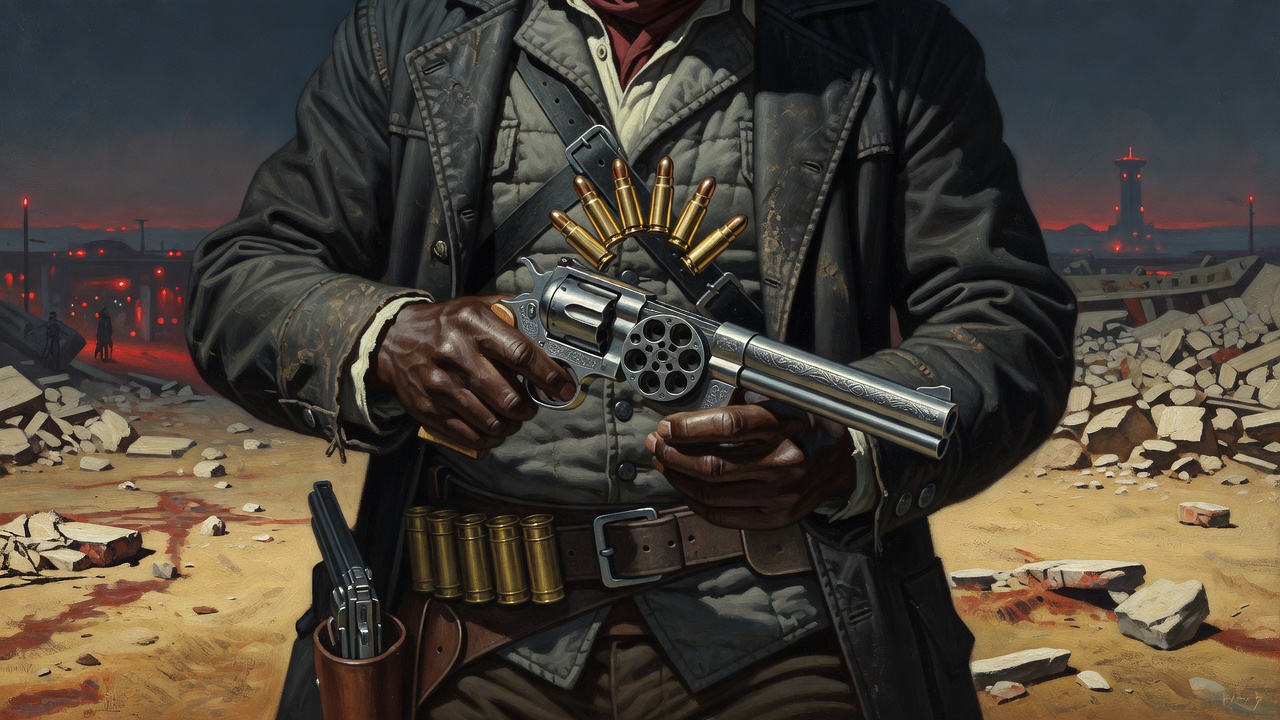
- Roland’s look and guns. Heavier, dark-eyed, close-bearded; the revolvers are engraved Remington-pattern pieces with light wood grips, with no Excalibur origin stated on screen.
- Jake’s family. His father is a fireman dead a year; there is a stepfather, Lon; his mother is killed by Walter. No Elmer Chambers, no Greta Shaw.
- Steven Deschain dies on screen at Walter’s word. In the books his death is off the page; only the Marvel comics show it, and not at Walter’s hand.
- Walter dies by Roland’s gun in a street duel. In Book VII, Mordred eats him.
- The ending. Roland keeps the boy instead of letting him fall; the pair leave New York for Mid-World, not End-World; the Tower is never a destination, only a distant spire under attack and then under repair.