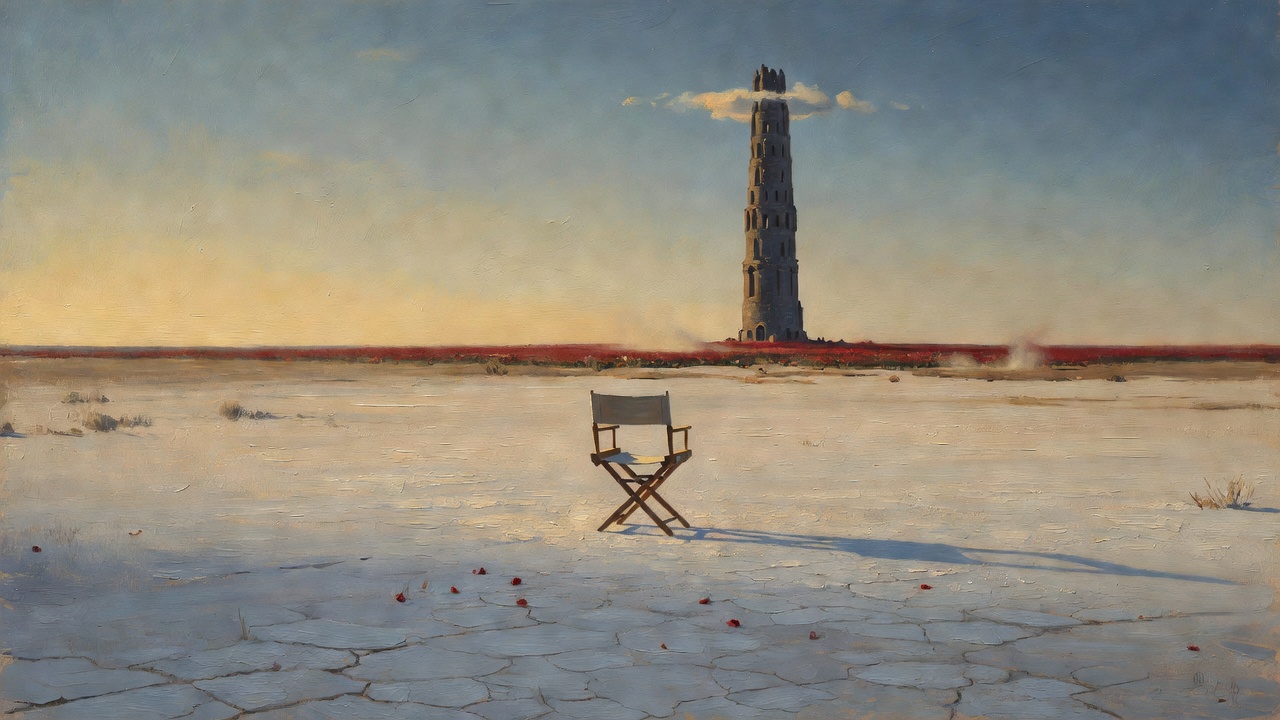
Adaptations · 1988 – 2026
The Unmade Ones
Four studios, one pilot in a drawer, one stack of approved scripts waiting on a green light, and the comics that drew the war the books only remember.
Between the last page of the seventh novel in 2004 and this morning, the Dark Tower has been optioned, announced, dated, cast, shot, shelved, re-bought and rewritten by four studios, one streamer twice, one comics publisher and the author’s own website. One film reached cinemas. One television pilot was finished, scored and never released. One series has had its first season written and approved by King and has not been ordered. The comics drew the fall of Gilead and stopped before the third door.
This page is the record of everything except the film, which has its own page and its own alignment table. Dates are the point. Every status claim below carries one, because status claims are the thing this property has most reliably produced.
And as of today, 6 October 2026, there is a new book: Other Worlds Than These, published this morning, which King calls a return to Mid-World. It is not an adaptation. It goes at the end of the shelf.
Four studios, ten years
The first option is the cheapest in the record. In February 2007 J.J. Abrams, Damon Lindelof and Carlton Cuse take the rights for a reported nineteen dollars, the number that haunts the later books, with King’s public blessing and Lindelof as the presumptive writer. Lost eats the next two years. Abrams floats a seven-film plan in September 2008, and in October 2009 Lindelof bows out, saying he would do anything to see the films written by someone else. In November 2009 Abrams tells MTV the project is no longer under consideration. The rights revert.
Universal pays real money in April 2010 (reportedly five million) and announces the most ambitious shape anyone has proposed: three feature films alternating with two television seasons that bridge them, Akiva Goldsman writing, Ron Howard directing, Brian Grazer and King producing. NBC Universal makes it official on 8 September 2010, and King, who always expected it to take more than one movie, says “I didn’t see this solution coming.” The first film is dated 17 May 2013. Then the budget. By May 2011 Universal is seeking co-financing and Goldsman is rewriting smaller; on 18 July 2011 the studio cancels.
Warner Bros. reads a revised Goldsman script in 2012 and passes on 20 August; Media Rights Capital opens talks the next day, takes it over and holds it. On 10 April 2015 Sony partners with MRC to fast-track a reworked Goldsman and Jeff Pinkner draft; Nikolaj Arcel signs on 10 July 2015 to direct and rewrite; cameras roll in South Africa on 12 April 2016; the release slides from 13 January 2017 to 17 February, to 28 July, to 4 August 2017. That film has its own page. One piece of it belongs here. In September 2016 a companion television series is announced for 2018 under showrunner Glen Mazzara, to adapt Wizard and Glass, The Wind Through the Keyhole and parts of The Gunslinger, with the film’s Roland and Jake returning. It never shoots. When Amazon takes the television rights in February 2018 the companion series is dead, and what Mazzara makes next is a reboot.
The pilot nobody saw
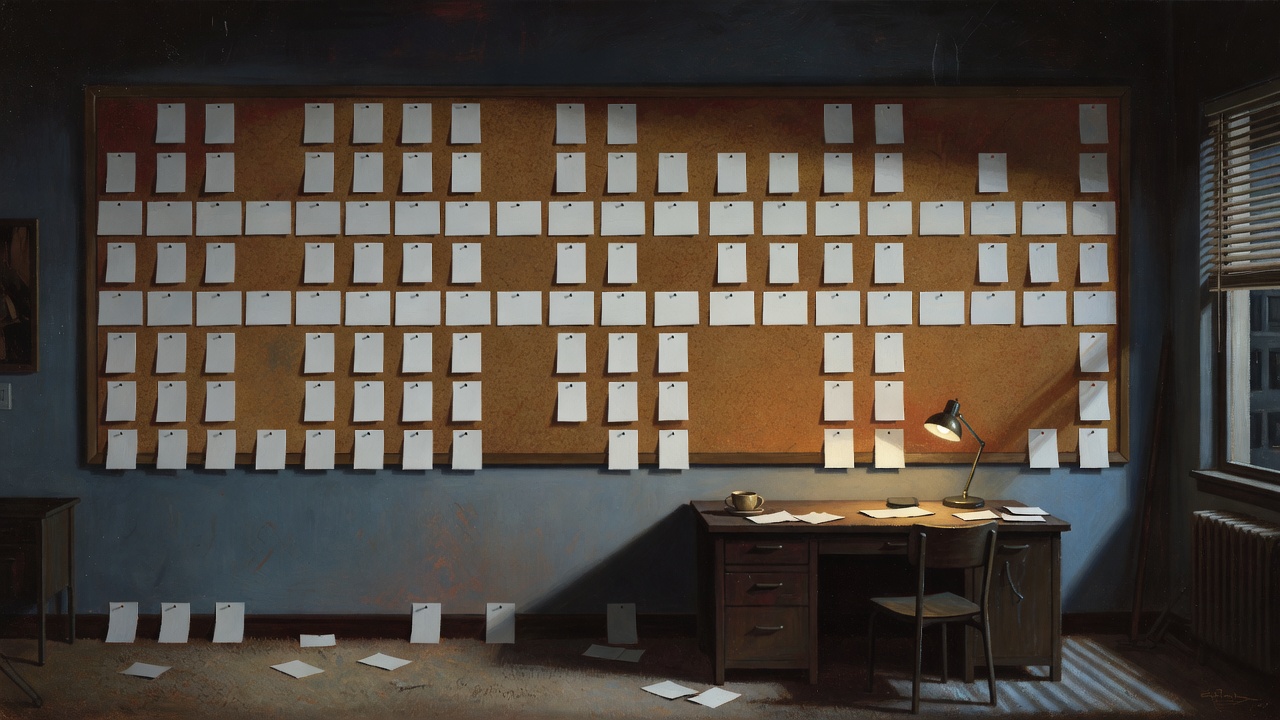
Amazon’s version is the closest the Tower has come to a television screen. On 21 March 2019 Variety and Deadline report the pilot’s leads, Sam Strike as Roland and Jasper Pääkkönen as the man in black, with Mazzara’s script already written and the casting running ahead of Amazon’s formal order. The series is to be built primarily on Wizard and Glass: Roland’s origin, how he wins his guns, his first conflict with the man in black, his first love, his first mission. A thirteen-episode first season is planned. Joana Ribeiro is cast as Susan Delgado on 29 May 2019; Michael Rooker and Jerome Flynn join; Elaine Cassidy and Ivan Kaye are named later. Stephen Hopkins directs. Bear McCreary scores. By 10 June 2019 the pilot is shooting in Croatia.
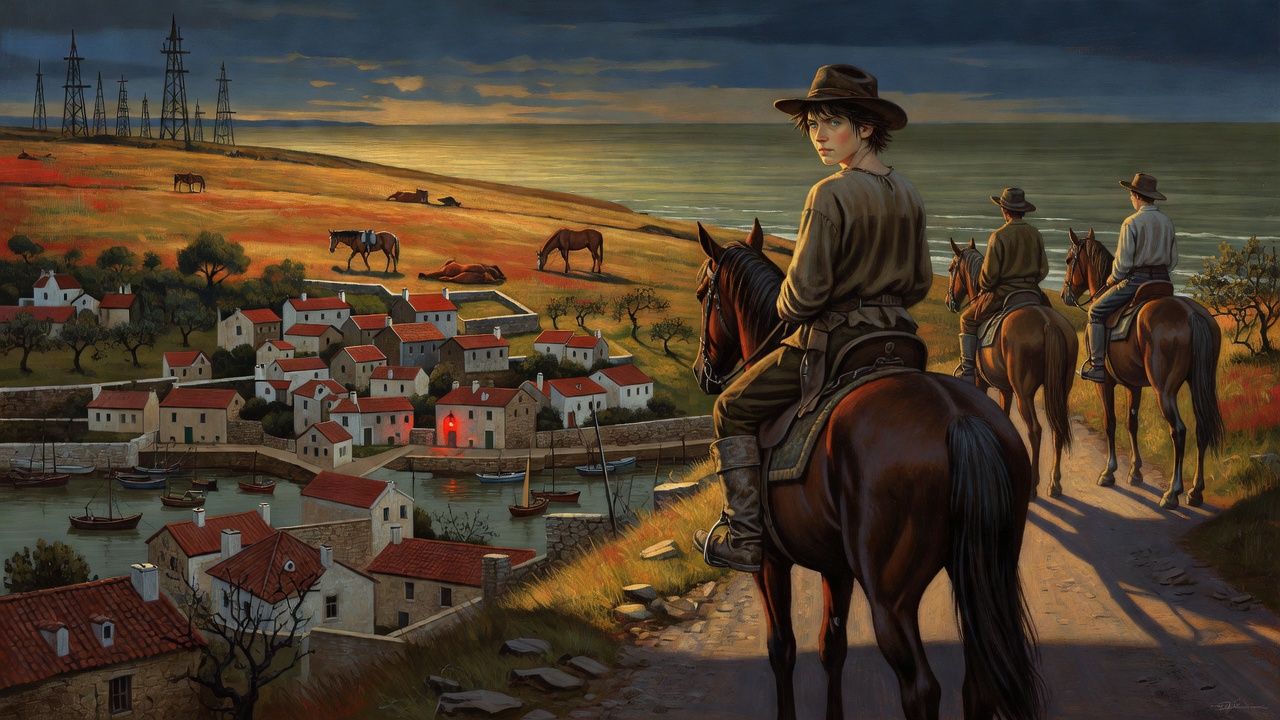
So the series is the Mejis story: a boy sent out of his father’s sight to a far sea-coast barony, who finds oil derricks pumping for the enemy, horses on the Drop that nobody is counting honestly, and a girl promised to the mayor. In the book, Hambry is fishing boats and orchards, the Travellers’ Rest, the long grass slope running down to the Clean Sea. The pilot itself, by the account of the one outlet that has seen it, runs fifty-seven minutes and does not start there: it opens on the first sentence of Book I, Roland chasing Marten across a desert, then cuts between Gilead, where Steven Deschain surveys Farson’s damage and Gabrielle frets over her son, and Hambry, where Susan Delgado is promised to Mayor Thorin; Cuthbert and Alain ride with him, the border-dweller Brown and his talking raven appear, and it closes on a vision of Roland killing his mother.
On 15 January 2020 Amazon passes. The reported reason is that the pilot was not on the level of the streamer’s other large-scope genre series. MRC shops the two finished scripts elsewhere; nothing comes of it. On 20 January 2020 Mazzara says he is proud of it and closes with the saga’s line: “There are other worlds than these.” On 10 June 2020 Lilja’s Library obtains a finished copy and publishes a positive review with screenshots, naming Jerome Flynn as Steven Deschain, Elaine Cassidy as Gabrielle Deschain, Ivan Kaye as Mayor Thorin and Pääkkönen’s man in black as Marten; a petition asking Amazon to release it follows on 1 July 2020. Amazon never comments. As of 6 October 2026 the pilot exists as a completed, scored episode that has never been officially shown.
Flanagan’s oil tanker
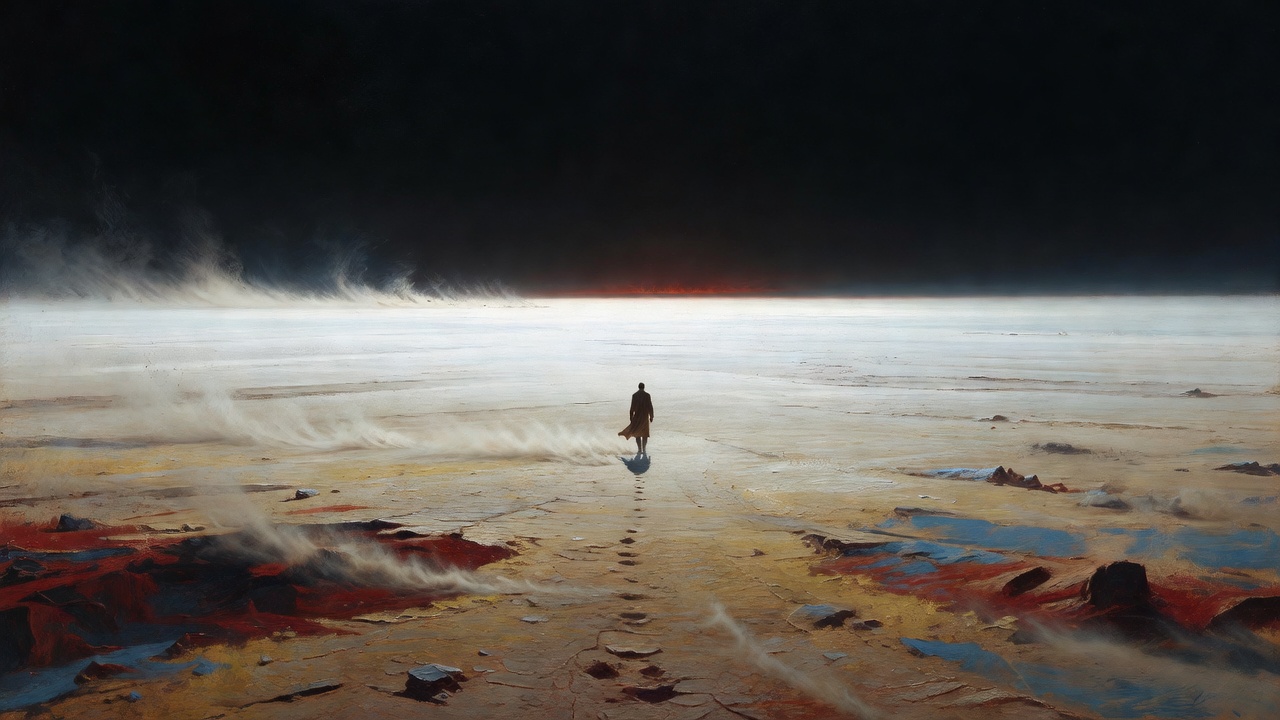
Mike Flanagan describes his opening shot before he owns anything. On 27 October 2022 he tells IGN how he would begin: a black screen, the first sentence coming up on it in silence, wind, then a fade-up on a landscape at Lawrence-of-Arabia scale with a silhouette crossing the hardpan. Doing it, he says, would be “my Everest.” On 8 December 2022, as he and Trevor Macy move Intrepid Pictures’ overall deal from Netflix to Amazon, they reveal they already hold the Dark Tower television rights, carved out of that deal and granted by King on the strength of a detailed outline. The shape: five seasons, then two standalone feature films. There is a pilot script and a season-one outline. There is no order.
From there the record is dated statements and no production. 9 August 2023: “completely frozen” by the strikes. 24 July 2024: Amazon MGM’s television chief Vernon Sanders is in “weekly conversations” with him. 6 September 2024: “That thing’s launching an oil tanker,” but further along than ever. October 2024, New York Comic Con: “You just do the books”; the same month Amazon orders his Carrie. 30 January 2025: King, having read screenplays and pitches, says “The beats are perfect.” (On 24 February 2025 King says on a stage that he is writing for it, and on Bluesky the same day that he is not. He is not.) 3 January 2026: a lot of scripts done, and of the 2017 film, “We can’t let that be the final word.” 12 February 2026: the season-one scripts are finished and King is happy with them. 11 September 2026: progress, and a green light slower than anything he has approached. 15 to 17 September 2026: “very much on the table” at Amazon, and the reason it is still a table is that the Dark Tower’s characters are scattered across studio ownership. Flanagan names none; the books borrow Callahan, Flagg, Brautigan and Danville from four other books. 3 October 2026: “It’s an oil tanker of a project,” the legal logistics “beyond intimidating,” rights moves that can take more than a calendar year. Asked when: “One of these days.”
Status as of 6 October 2026: in development at Amazon MGM Studios under Flanagan and Intrepid; season-one scripts written and approved by King; no series order, no cast, no production date. Not shelved and not greenlit. Tomorrow, 7 October 2026, his eight-episode Carrie lands on Prime Video, the project that went ahead of it in the queue.
Fifteen arcs on another level of the Tower
Marvel’s comics ran from February 2007 to February 2017, and for most of that decade they were the only Dark Tower anyone was making. Robin Furth, King’s research assistant and the author of the Concordance, plotted every arc; Peter David scripted nearly all of them; Jae Lee pencilled four of the five Beginnings arcs with Richard Isanove’s painted colour (Isanove drew The Fall of Gilead himself), and Isanove carried the look afterwards. King is credited as Creative and Executive Director. He asked Marvel for Furth, answered her questions, and did not write them.
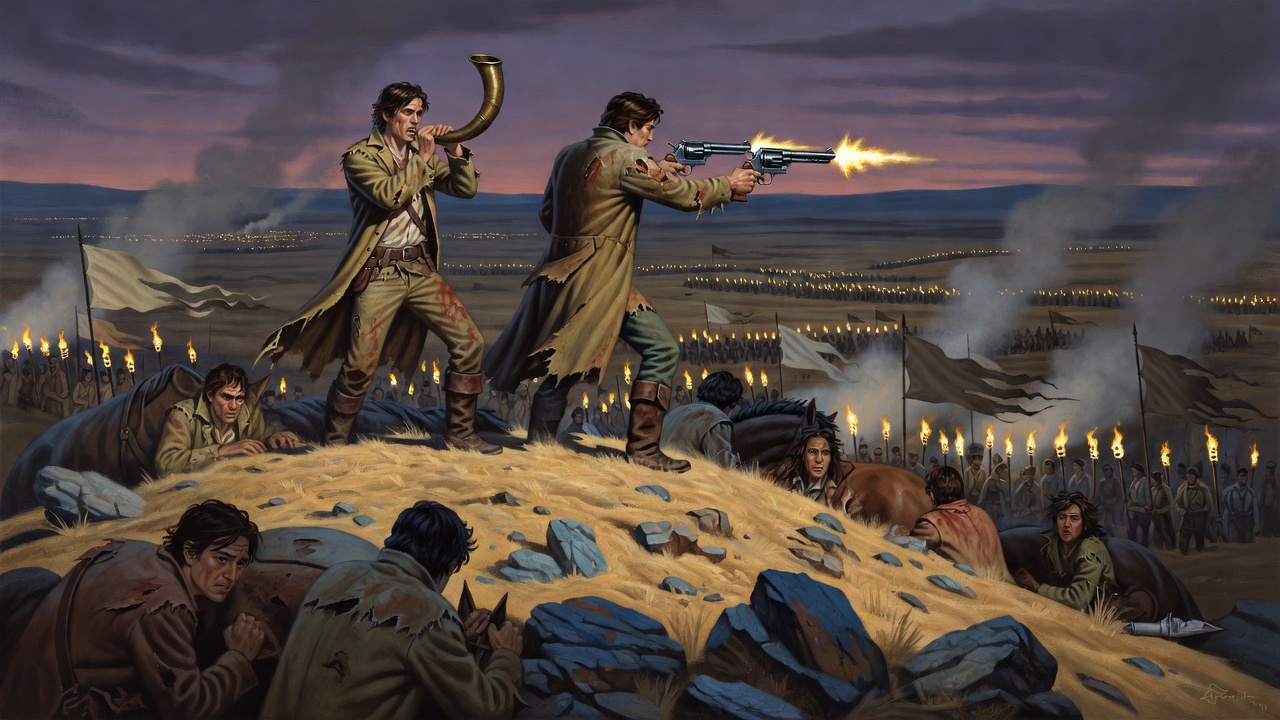
Three cycles. Beginnings (2007 to 2010) is the prequel. The Gunslinger Born (7 February to 1 August 2007) adapts the Mejis story from Wizard and Glass; then The Long Road Home, Treachery, Sorcerer, The Fall of Gilead and The Battle of Jericho Hill (ending 21 April 2010) draw the years the novels only remember: the ride home with the Wizard’s Glass, Roland’s mother, Farson’s assault on Gilead, the deaths of Steven Deschain and Cort, and the last stand on the hill where Cuthbert blows the Horn of Eld and Roland leaves it in the dust. The Gunslinger (2010 to 2013) bridges from Jericho Hill, adapts The Little Sisters of Eluria, then walks the first novel in three arcs (The Battle of Tull, The Way Station, The Man in Black), with three invented specials collected as Last Shots. The Drawing of the Three (September 2014 to 8 February 2017) spends two arcs each on Eddie’s and Odetta’s backstories and one, The Sailor, on Jake in New York. Then Marvel’s licence ends. Jack Mort and the third door were never drawn. Fifteen arcs, some eighty issues plus specials, and the adaptation of the novels stops partway through Book II.
The canon rule is Furth’s, in her own words: “The only truly canonical Dark Tower works are those written by Stephen King himself.” Everything else sits “on a slightly different level of the Tower,” a parallel level near the Keystone world but not it, which is the books’ own device for versions that disagree. It is a generous rule and a precise one: the comics’ Jericho Hill is invention anchored to hints, King-approved and not King-written.
Marvel collected one volume per arc, with two omnibuses (2011 and 2014). In June 2018 Gallery 13, Simon & Schuster’s graphic-novel imprint, took over the collected rights and reissued all three cycles with boxed sets in 2018, 2019 and 2020, and two omnibuses: Beginnings (1 May 2020) and The Gunslinger (24 October 2023), which as of October 2026 is the most recent Dark Tower comics release on record.
The rest of the shelf
The Little Sisters of Eluria (1998) is the cycle’s one freestanding novella, written for Robert Silverberg’s Legends anthology, collected in Everything’s Eventual (2002), set after Mejis and before Tull, in which a wounded Roland wakes among vampire nuns. Donald M. Grant paired it with the revised Gunslinger in 2009, with Michael Whelan plates.
Robin Furth’s Stephen King’s The Dark Tower: A Concordance began as her private index for King while he finished the last three books. Volume I (2003) covers Books I to IV, Volume II (2005) covers V to VII, The Complete Concordance (5 December 2006) merges them with a foreword by King, and the Revised and Updated edition (6 November 2012) adds The Wind Through the Keyhole.
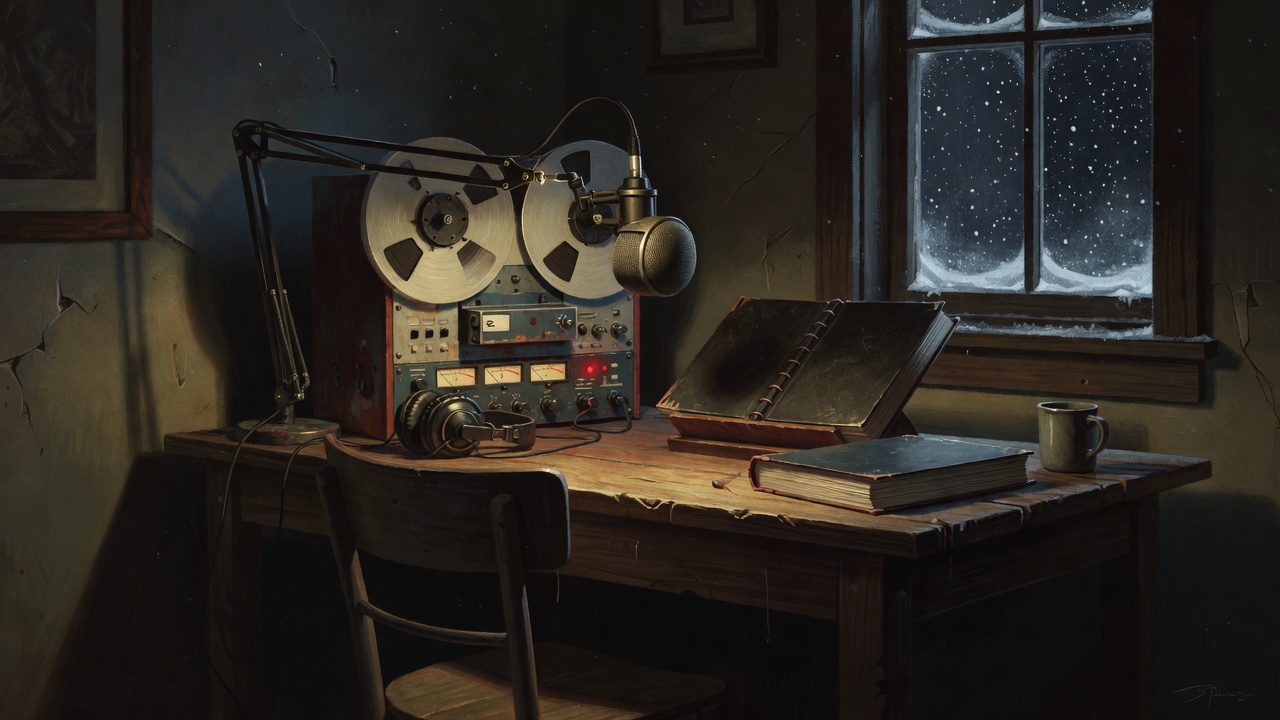
The audiobooks are three voices, and the author’s is both the first and the latest. King read the original Gunslinger himself for New Audio Library in January 1988, and read The Drawing of the Three the same way in January 1989. Frank Muller then recorded the first four books (his Drawing of the Three from Penguin Audio, July 1991); King thanks him in the afterword to Wolves of the Calla, and Muller’s motorcycle crash on 5 November 2001 ended his career. George Guidall recorded the revised Gunslinger in June 2003 (keeping Muller’s voices for Roland and Jake, by AudioFile’s review), then V, VI and VII in 2003 and 2004. King came back to the microphone for The Wind Through the Keyhole (24 April 2012, ten hours and twenty-one minutes).
Discordia is the only official game, and it is a browser story: stephenking.com’s own production, launched 7 December 2009, with Michael Whelan illustrations and Robin Furth among the credits; King authorised it and did not write it. A Tet Corporation agent against the Sombra Corporation, through the Dixie Pig and Castle Discordia. Chapter 1 only; Chapter 2 was promised for 2015 and never arrived; the page still runs in a browser as of 6 October 2026. There is no licensed Dark Tower board, card or video game. Return to Dark Tower (2022) revives a 1981 Milton Bradley game with no connection to King.
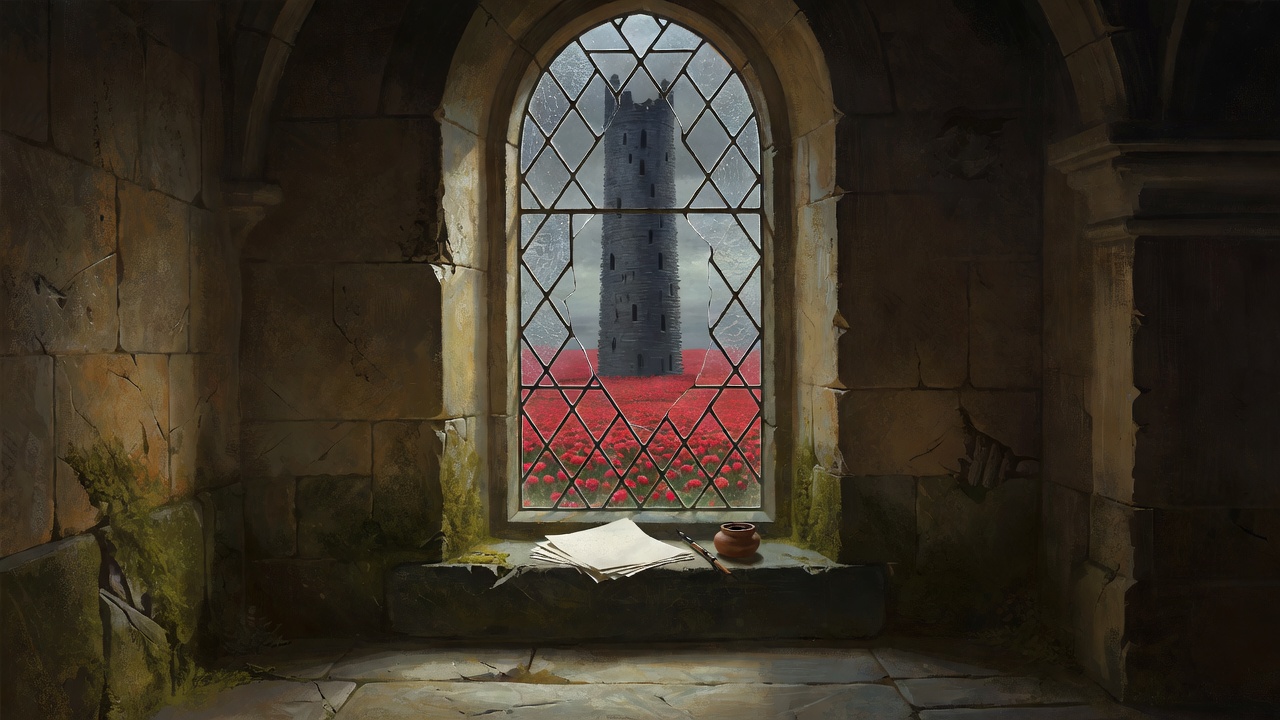
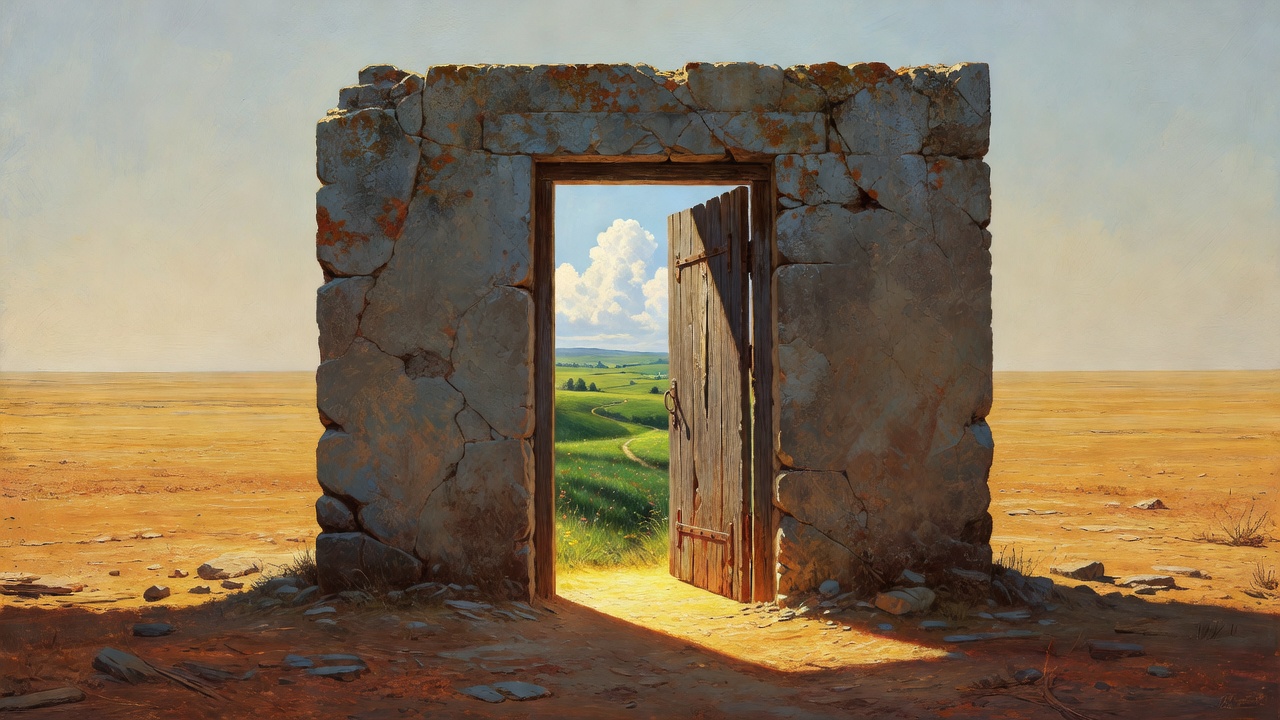
The painted lineage these frames nod to is Donald M. Grant’s, whose hardcovers gave each volume one artist’s colour plates: Michael Whelan (I, 1982), Phil Hale (II, 1987), Ned Dameron (III, 1991), Dave McKean (IV, 1997), Bernie Wrightson (V, 2003), Darrel Anderson (VI, 2004), Whelan again for VII (2004) and the 2009 Eluria, and Jae Lee for The Wind Through the Keyhole (2012).
And today. Other Worlds Than These (Scribner, 6 October 2026, 624 pages, credited to Stephen King and Peter Straub, thirty black-and-white illustrations by Gabriel Rodríguez) is the third Talisman book, not a numbered Dark Tower volume, but King frames it as a homecoming: “I wanted to go back to Mid-World, which was always the Territories by another name.” The first new Mid-World novel since 2012, and not an adaptation. It is the one new Dark Tower object of 2026 that is not a status update.
Where the 2017 film sits in this record
- The 2017 film is the one attempt in this record that reached a screen: Sony and MRC, released 4 August 2017, budget $60–66M depending on the tracker, worldwide gross $113.2M, 16% on Rotten Tomatoes, no sequel.
- It is the end of the Goldsman lineage: the Universal three-films-two-seasons plan of 2010, the revised script Warner passed on in August 2012, MRC’s long hold, and Sony’s 2015 fast-track with Nikolaj Arcel rewriting.
- Its makers framed it as a sequel to the books rather than an adaptation (Roland carries the Horn of Eld); Arcel said in August 2017 that a second film would adapt The Drawing of the Three, and by 2019 Ron Howard was saying the PG-13 rating had been the wrong call.
- Its companion television series, announced in September 2016 with Glen Mazzara as showrunner, died when Amazon took the television rights in February 2018; the pilot Mazzara then made was a reboot, not a tie-in.
- Flanagan, 3 January 2026, on the film: “We can’t let that be the final word.”
- The film is walked scene by scene on its own page, and set against its sources on the Books vs. Film page.
Status as of 6 October 2026
- Released films: 1. The Dark Tower (Sony/MRC, 4 August 2017). No sequel.
- Aired series: 0. The 2016 companion series was never made.
- Unaired pilots: 1. Amazon/MRC, written by Glen Mazzara, shot in Croatia from June 2019, passed on 15 January 2020, finished and scored, never officially released.
- Series in development: 1. Mike Flanagan and Intrepid Pictures at Amazon MGM Studios; season-one scripts written and approved by King (12 February 2026); “very much on the table” (September 2026); no series order, cast or production date as of 3 October 2026.
- Comics: complete. Marvel, 2007 to 2017, fifteen arcs in three cycles, some eighty issues plus specials; Gallery 13 reprints 2018 to 2023; the adaptation of the novels stops partway through The Drawing of the Three.
- New prose: 1. Other Worlds Than These, published 6 October 2026. A return to Mid-World, not an adaptation.